

Converting Technical Trials to Paid: The 2026 Activation Fix
You launch on Product Hunt. GitHub stars pile up. Within 48 hours, you have 1,000 signups.
Thirty days later, your conversion rate is zero.
You built a user base. You didn't build revenue.
This is the passive PLG trap. And in 2026, it's a runway killer.
The Free User Problem Just Got Expensive
In 2021, free users were an asset. Server costs were cheap. Capital was abundant. You could afford to let developers sit on your free tier forever, hoping they'd eventually convert.
That math is dead.
AI-native products now carry real COGS (Cost of Goods Sold) per user. Every API call burns tokens. Every background sync costs compute. Every LLM response generates a direct, metered expense.
The margin compression is measurable:
| Metric | Traditional SaaS | AI-First SaaS |
|---|---|---|
| Variable COGS | Less than 5% | 20-40% |
| Gross Margins | 80-90% | 50-60% |
| Cost per Enterprise User (50M tokens/month) | Negligible | $500-2,000/month |
Your free tier isn't a growth engine anymore. It's a cash incinerator. Every user who doesn't convert is now actively burning your runway.
The Activation Gap: Why Signups Don't Equal Revenue
Before fixing your funnel, you need to understand the difference between two metrics that most founders conflate:
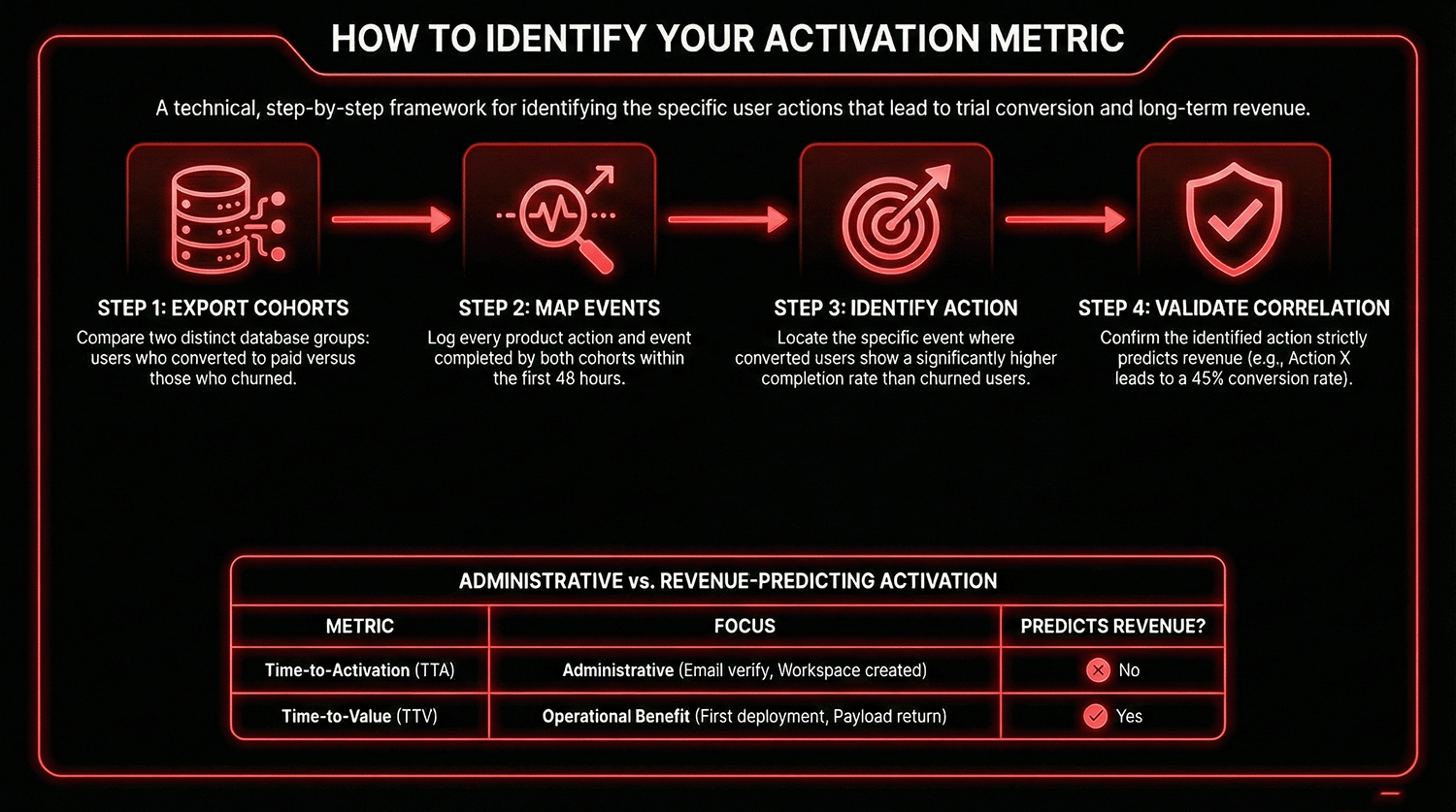
Time-to-Activation (TTA): How quickly a user completes an administrative action (email verified, workspace provisioned, API key generated). This measures compliance with your onboarding flow.
Time-to-Value (TTV): How quickly a user experiences the actual benefit of your product (first successful deployment, first automated workflow, first problem solved). This predicts revenue.
High activation can coexist with catastrophic retention. A developer who generates an API key has activated. A developer who uses that key to successfully return a payload has reached value. Only the second metric correlates with conversion.
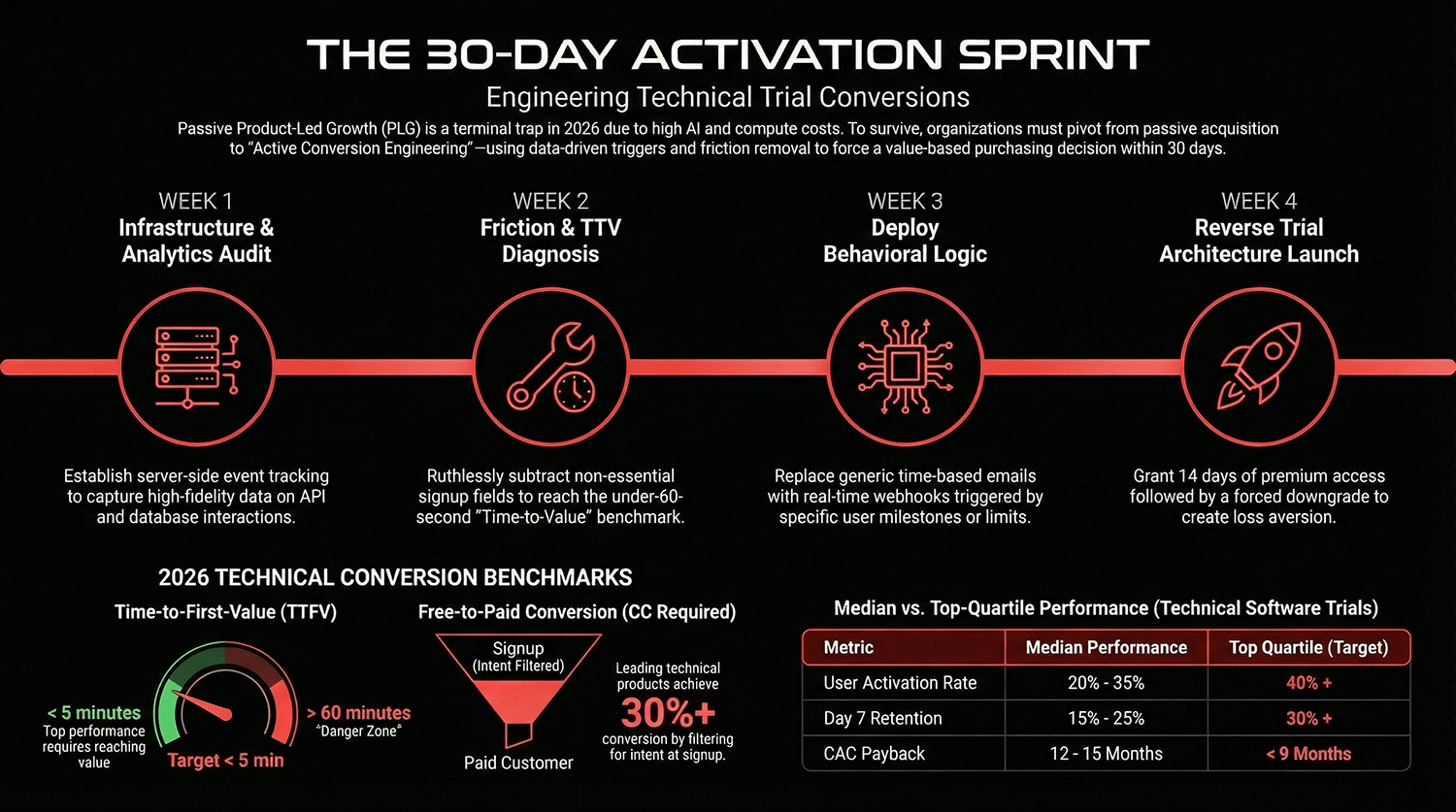
The window for delivering value is shrinking. For top-quartile technical tools, TTV benchmark is under 5 minutes. For AI-native platforms, the threshold is under 60 seconds.
2026 Trial Conversion Benchmarks
| Trial Type | Conversion Rate | Best For |
|---|---|---|
| Opt-in (no credit card) | 18-25% | High signup volume, requires strong activation |
| Opt-out (credit card required) | 49-60% | Lower volume, higher intent filter |
| Freemium to paid | 2-5% | Only viable with massive volume |
| 7-day trial | 40.4% | Creates urgency |
| 61+ day trial | 30.6% | Delays decision |
Diagnostic thresholds:
- •Opt-in trial converting below 15%: Activation is broken
- •Opt-out trial converting below 40%: Value delivery is broken
- •Freemium converting below 2%: Paywall placement is broken
Phase 1: Engineering the True Activation Metric
Most founders track the wrong milestone. They celebrate “workspace created” or “API key generated.” These are setup steps. They don't predict conversion.
Definition: The activation metric (sometimes called the “Aha! Moment”) is the specific user action that statistically correlates with long-term retention and trial conversion. It represents the exact moment a user grasps and internalizes the product's core value.
Examples by product type:
- •Communication tools: 2,000 messages sent (Slack's historical metric)
- •Developer tools: First successfully deployed script or formatted API response
- •AI platforms: First task delegated to an agent and shipped without manual correction
- •Data infrastructure: First successful reverse-ETL synchronization
How to Identify Your Activation Metric
The process requires database-level cohort analysis, not marketing assumptions. (Everybody needs to work together. I said it once and I'll say it again)
Step 1: Export two cohorts from your database: users who converted to paid and users who churned during trial.
Step 2: Map the product events each cohort completed within the first 48 hours.
Step 3: Identify the specific action that converted users completed at a significantly higher rate than churned users.
Step 4: Validate the correlation. If users who complete Action X within 24 hours convert at 45%, while users who only complete setup steps convert at 3%, Action X is your activation metric.
Critical note on tracking: Standard client-side analytics (browser cookies, pixels) suffer 20-30% data loss with technical audiences due to ad blockers and privacy tools. Server-side event tracking is required for accurate measurement. You can read more about it here.
The Attention Capture Problem
I worked with a team at Antler who built a CLI tool. Brilliant product. Thousands of downloads. But they had no mechanism to capture that attention. No path from “downloaded” to “activated” to “paying.”
The validation felt real. All those downloads. But without a conversion funnel, they were just generating compute costs.
This pattern repeats constantly. Technical founders focus on the tool, not the funnel. They get validation (downloads, signups, GitHub stars) and assume conversion will follow.
It doesn't. Attention without capture is attention wasted.
Phase 2: The Behavioral Trigger Engine
Traditional trial sequences are time-based:
- •Day 1: Welcome email
- •Day 3: Feature highlight
- •Day 7: Trial halfway reminder
- •Day 14: Upgrade warning
This approach treats every user identically regardless of their actual product behavior. It's a notification log, not a conversion engine.
A user who integrated your API in the first 10 minutes doesn't need a Day 3 email explaining how integration works. A user stuck on a broken script doesn't care that their trial is halfway done.
The fix: Replace time-based sequences with behavioral triggers that fire based on actual product events.
The Core Behavioral Trigger Playbook
| Trigger Event | Fires When | Message Strategy |
|---|---|---|
| Stalled Setup | User creates account but doesn't complete activation action within 24 hours | Friction removal: specific guidance on the exact blocker, not generic “checking in” |
| Aha! Moment Achieved | Database registers completion of activation metric | Congratulatory upgrade prompt capitalizing on peak satisfaction |
| Usage Limit Warning | User reaches 90% of free tier allocation | Validate successful usage + surface impending limit + one-click upgrade path |
| High Velocity Engagement | Multiple logins or team invites within 72 hours | Team expansion prompt: enterprise security, role permissions, team pricing |
| Feature Abandonment | User starts complex configuration but abandons before saving | State recovery: pull specific workflow name, provide one-click return to saved state |
The Integration Tourist Problem
At Clerk.io, the sales team would sign people up. The product was strong. The assumption was: once they try it, they'll convert.
But sales was always chasing the next deal. Users would start the trial, complete the integration with support, and then go silent. No triggers to nudge them. No behavioral emails based on usage.
The result: extended trials, longer sales cycles, deals that never closed.
The fix required coordination between engineering and marketing. Product events needed to pipe into the CRM. It was simple to implement, but it required the two teams to actually work together.
Behavioral Trigger Mapping Template
The 5-trigger framework with pre-built examples, webhook setup for Zapier/Make/n8n, and a quick reference card for implementation.
Phase 3: UI Subtraction and Forced Decisions
The most persistent structural flaw in trial experiences: too much friction at signup, too little friction at decision time.
UI Subtraction: The Rule of Two
Every non-essential field on your signup form destroys conversions. Company size, job title, phone number, use case dropdown.
Technical users see a 10-field form and leave.
The Rule of Two: Your primary signup screen should require only two inputs maximum: email and password. Or ideally, single sign-on via GitHub, Google, or Microsoft.
Collect enrichment data after activation, not before. Ask for company size after they've experienced value, when they have a reason to continue the conversation.
Progressive disclosure: Show fewer choices early. Hide advanced settings, complex configurations, and demographic questionnaires until after the user has completed a value-driving task.
The Reverse Trial Architecture
Standard freemium fails because it lacks a forcing function. Users settle into the free tier, extract baseline value, and never face a decision point. This is why freemium converts at 2-5%.
The Reverse Trial combines immediate gratification with forced decision:
Days 1-14: Grant full premium access. All features. Maximum compute. No restrictions. The user builds workflows dependent on premium capabilities.
Day 15: Graceful downgrade to a heavily restricted free tier. Read-only dashboards. Throttled API. No team features.
The psychology is loss aversion. The user experienced the optimal state. Returning to a restricted state feels like losing something they already had.
Conversion impact: Reverse trials push free-to-paid conversion rates toward the 15-25% range, significantly outperforming standard freemium models.
The Freemium Squatter Problem
At Falcon Social (now Brandwatch), we benchmarked everything against Hootsuite. Freemium made sense early. You need users. You need feedback. You need market validation.
But it gets expensive fast.
Hootsuite struggled massively to move their massive free user base to paid, Falcon kept growing. When The Hub tried to introduce paid features after years of freemium, existing users just looked for those features at competitors. The model had trained them to expect free forever.
The lesson: If you start with freemium, design the upgrade path from day one. Gate workflow efficiency (speed, concurrent jobs, bulk operations), not just volume. Make the free experience functional but just painful enough that paying becomes the obvious choice.
Phase 4: Identifying and Throttling Resource Drains
Not every free user is a future customer. Some are actively costing you money with zero intent to pay.
Profile 1: The Integration Tourist
Behavior: Authenticates cloud providers, syncs databases, generates API keys. Then disappears. High setup activity, zero functional usage.
Action: If no functional command is executed within 7 days of setup completion, automatically pause background syncing. Require manual login to re-initiate. Stop burning compute on dormant accounts.
Profile 2: The Freemium Squatter
Behavior: Carefully modulates usage to stay just below paywall thresholds. Monitors dashboards. Adjusts activity to avoid triggering upgrade prompts.
Action: Gate workflow efficiency, not just volume. Slower sync speeds, limited concurrent jobs, no bulk export on free tier. Let them stay under the usage limit while making the experience just painful enough that paying becomes preferable.
Profile 3: The Automated Scraper
Behavior: Disposable email domains. Instant consumption of API limits within minutes of account creation. Headless browser signatures.
Action: Require domain verification before granting high-capacity API access. For products with substantial free compute, move to credit-card-required trials. Opt-out trials filter zero-intent actors immediately while converting at 49-60%.
The 30-Day Activation Sprint
Fixing trial conversion is not a six-month roadmap. It's a 30-day operational sprint.
Week 1: Infrastructure Audit
Objective: Establish data visibility.
- ✓Audit CRM, product database, and event tracking integration
- ✓Identify delta between reported signups and tracked product events
- ✓Verify that when a user clicks a value-driving button, the event registers in your marketing automation tool
Milestone: Functioning event tracking schema with zero data loss between product and CRM.
Week 2: Friction Diagnosis
Objective: Locate and eliminate conversion blockers.
- ✓Map the complete user journey from landing page to activation metric
- ✓Execute cohort analysis to identify the specific hour, day, or screen where users abandon
- ✓Remove all non-essential data collection from signup flow
- ✓Implement progressive disclosure for advanced settings
Milestone: Users reach core dashboard within 60 seconds of signup.
Week 3: Behavioral Logic Implementation
Objective: Replace time-based sequences with event-driven triggers.
- ✓Disable existing time-based drip campaigns
- ✓Build three core webhooks: Stalled Setup (fires at hour 24), Aha! Moment (fires on activation), Usage Limit (fires at 90% capacity)
- ✓Draft contextual email copy that pulls user-specific product data (repository names, query counts, workflow titles)
Milestone: Internal testing confirms triggers fire correctly and emails display dynamic content accurately.
Week 4: Architecture Launch
Objective: Deploy forcing mechanisms and establish baseline metrics.
- ✓If on freemium: launch reverse trial pilot for new signups
- ✓Rewrite upgrade screens to emphasize specific value delivered (“Your 12 deployments this week saved approximately 4 hours of manual work”) rather than feature lists
- ✓Configure billing system for automatic downgrade at trial end
- ✓Establish baseline conversion metrics for ongoing optimization
Milestone: New trial architecture live. Behavioral sequences active. Baseline conversion rate documented.
The Execution Gap
The reason most technical products fail at conversion isn't strategy. It's the gap between engineering and marketing.
When trial conversion stalls, technical founders assume they need more features. Traditional marketers assume they need more ad spend.
Both are wrong.
The fix requires a hybrid profile: someone who can deploy server-side tracking, configure webhooks between the product database and CRM, and write copy that translates technical value into psychological urgency.
Required capabilities:
- •Data infrastructure: Server-side event tracking (PostHog, Amplitude, Segment)
- •Automation: Webhook configuration between product database and marketing automation (Zapier, Make, n8n, or custom)
- •Messaging: Ability to translate technical product events into conversion-focused copy
Without this capability, you'll keep running time-based sequences that ignore what users actually do. And you'll keep wondering why nobody converts.
Summary: The Activation Fix Framework
Product-Led Growth gets users in the door. An engineered activation strategy forces them to stay.
The 2026 reality:
- •AI compute costs make passive PLG unsustainable
- •Free users who don't convert are now actively burning runway
- •Trial conversion is an engineering problem, not a marketing problem
The fix:
- ✓Identify your true activation metric through database cohort analysis
- ✓Replace time-based email sequences with behavioral triggers
- ✓Subtract friction from signup; add friction at decision time
- ✓Implement reverse trials to force purchasing decisions
- ✓Throttle resource drains who have zero intent to pay
The technical products that win aren't the ones with the most GitHub stars. They're the ones that engineered the fastest path from signup to payment.
Engineer the path from signup to payment. Everything else is noise.

About Judie Alvarez
Judie Alvarez is a fractional CMO who helps technical founders convert free users into paying customers. She has built activation frameworks for PLG products across developer tools, AI platforms, and data infrastructure.
Learn more →Get the Behavioral Trigger Mapping Template
The 5-trigger framework with pre-built examples, webhook setup for Zapier/Make/n8n, and a quick reference card for implementation.
Related Articles

The Four Gaps Killing Your Landing Page

The Technical Founder's Guide to the First Marketing Hire