

The Four Gaps Killing Your Landing Page
Someone lands on your page. They scroll for eight seconds. They leave.
You check the analytics. Bounce rate: 67%. Conversion rate: 2.1%. You assume the design is wrong. Or the copy needs work. Or maybe you need better traffic.
None of that is the problem.
The problem is a gap. Actually, four of them.
The median B2B SaaS landing page converts at 3.8%. That means 96% of visitors don't take action. Most founders respond by adding more copy, more features, more social proof. They're solving the wrong problem.
The real question isn't “how do I make my page convert better?” It's “what does my customer need to understand about how my product solves their problem, in a way they actually understand?”
Everything else is noise.
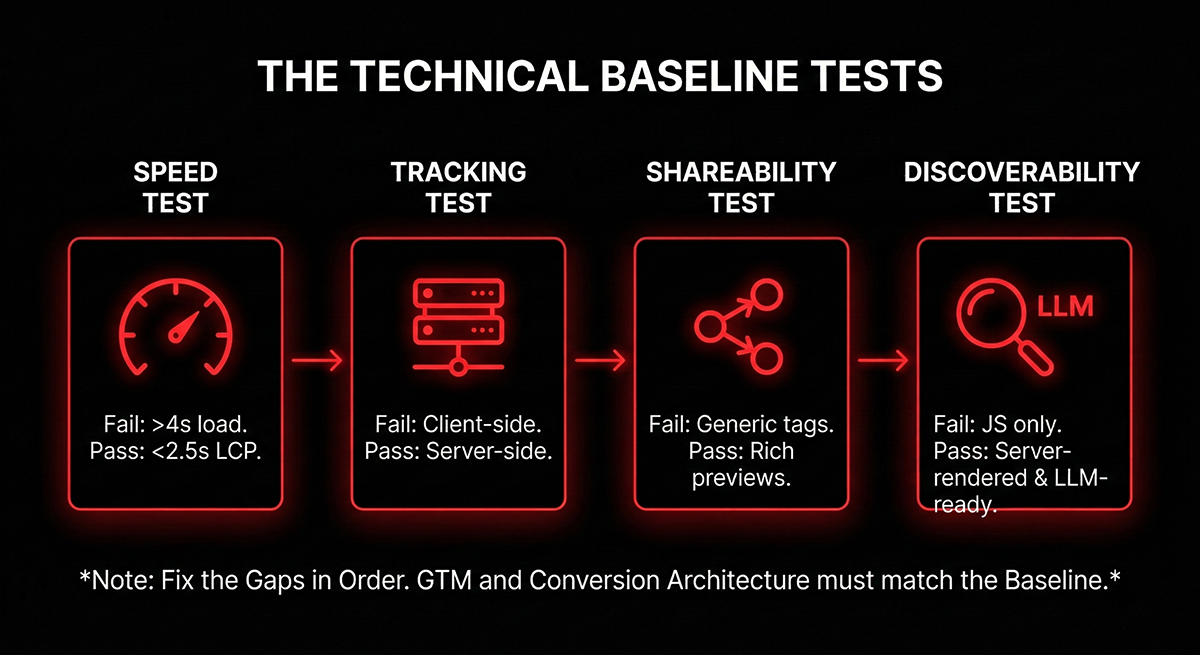
The Four Gaps Framework
Most landing pages fail because of invisible gaps between what the founder knows and what the customer experiences. Close these four gaps, and conversion takes care of itself.
| Gap | What's Broken | The Symptom |
|---|---|---|
| The Translation Gap | Your product does X, but customers don't understand what X means for them | High traffic, low engagement. Visitors leave before scrolling. |
| The Path Gap | They understand the value but don't know what to do next | Engaged visitors who never click. Time on page looks good, conversions don't. |
| The Stakeholder Gap | One person gets it, but they can't explain it to their team | Demos booked, deals stalled. Champions go dark after internal meetings. |
| The Capture Gap | They're not ready now, but you have no way to stay in their world | 96% of traffic leaves without a trace. No second chances. |
Each gap compounds the next. Fix them in order.
Gap 1: The Translation Gap
Definition: The distance between what your product does and what your customer understands it does, in their language.
Your landing page probably describes your product accurately. That's the problem. Accurate isn't the same as understood.
At Clerk.io, the initial messaging was technically correct. The product did exactly what we said it did. But ecommerce owners, who aren't always technical, couldn't translate the description into value for their business. They'd read the page, nod, and leave. Not because the product was wrong. Because the translation was wrong.
We fixed it by adding ecommerce education and video case studies. We showed them what integration actually looked like in hours, not weeks. We spoke in outcomes they recognized, not features we were proud of. The conversion moved fast after that.
The 5-Second Test
Can a first-time visitor understand what your software does and why it matters to them within five seconds of landing on the page? If the answer is no, clarity is the gap. Not design. Not copy length. Clarity.
The Translation Gap Diagnostic
Ask these questions about your landing page:
- •Does your headline describe what you do, or what changes for the customer?
- •Would your customer use the same words you're using, or are you speaking in product language?
- •If someone read only your headline and subhead, would they know if this is for them?
- •Are you describing features, or are you describing the problem going away?
Translation Gap Benchmark
| Metric | Warning Sign | Target |
|---|---|---|
| Bounce rate (organic) | Above 70% | Below 50% |
| Avg. time on page | Under 30 seconds | Above 90 seconds |
| Scroll depth | Under 25% | Above 60% |
High bounce and low scroll usually mean the visitor couldn't translate your message into relevance. They left before they understood.
Gap 2: The Path Gap
Definition: The distance between understanding your value and knowing what to do next.
They get it. They're interested. Now what?
If the only answer is “Book a Demo,” you've created a gap. Not everyone is ready for a 30-minute call. Not everyone wants to talk to sales. And if your ACV is low, you're burning expensive human time on conversations that should be self-serve.
At Tryp, we discovered the path was blurry. Call-to-actions weren't clearly marked. Upsells weren't easy to find. People wanted to buy but couldn't figure out how. The fix wasn't complicated. We created visual hierarchy. Made the primary action impossible to miss. Gave the page a clear direction instead of competing options. Conversion improved significantly. Not because the product changed. Because the path became obvious.
Multiple Conversion Paths
The data on this is clear. 18% of B2B SaaS websites now have interactive demo CTAs, up 40% year-over-year. The top 1% of interactive demos achieve 71% click-through rates. But you don't need expensive tooling to fix the path gap.
Options that work:
- ✓Self-service trial (no credit card required for low-friction entry)
- ✓Prerecorded demo or product walkthrough video
- ✓Interactive product tour (Navattic, Storylane, Arcade, or a simple recorded walkthrough)
- ✓Technical documentation with clear “get started” path
- ✓Live demo request (for those who want it)
At Clerk.io, we built a self-checkout path for small accounts. No human contact required during the 15-day trial. They could integrate and try by themselves. Small accounts closed faster because the path was clear. Larger accounts still went through sales, but they arrived more qualified.
The Path Gap Diagnostic
- •If someone lands on your page at 3am on a Sunday, can they convert?
- •Do you have paths for both “ready to buy” and “ready to explore”?
- •Is your primary CTA the only CTA, or do you offer alternatives?
- •Can a technical evaluator dig into documentation without talking to anyone?
Path Gap Benchmark
| Metric | Warning Sign | Target |
|---|---|---|
| CTA click rate | Under 2% | Above 5% |
| Demo completion rate | Under 40% | Above 65% |
| Trial starts outside business hours | Under 20% | Above 40% |
If your conversions cluster during your sales team's working hours, you have a path gap. The path only works when humans are available. And that, my friend, is expensive. For you and your business.
90-Day GTM Framework
Messaging, positioning, and conversion architecture step by step. Translation, path, and stakeholder alignment. All together in one framework.
Gap 3: The Stakeholder Gap
Definition: The distance between one person understanding your value and the entire buying committee understanding it.
B2B purchases now involve an average of 10 internal stakeholders. Enterprise deals average 13 internal plus 9 external participants. 79% require CFO approval.
You're not selling to one person. You're selling to a room.
The junior developer evaluating your tool cares about implementation speed and documentation. The CTO signing the check cares about security, compliance, and ROI. The finance lead wants to know about pricing and payback. One message doesn't work for all of them.
Worse: more than 40% of B2B deals stall because stakeholders fail to align. The biggest competitor isn't another vendor. It's “no decision.” Committees that can't reach consensus just don't buy.
At Clerk.io, the ecommerce business owner would make the initial decision, then talk to their developer about implementation. Information gets distorted from person to person. Having resources for both technical and non-technical stakeholders meant we served the whole buying committee, not just whoever landed first.
The Stakeholder Split
Supabase does this well. They built separate pathways for two audiences:
The Implementer Track
Step-by-step tutorials and technical documentation for developers who need to ship quickly.
The Decision Maker Track
Architecture overviews, security documentation, compliance certifications, and pricing logic for the people approving the purchase.
They scaled to 4.5 million developers by recognizing this split. Different stakeholders need different content. Not dumbed down. Not overwhelming. Matched.
The Stakeholder Gap Diagnostic
- •If your champion needs to explain your product to their CTO, do they have the materials to do it?
- •Does your site have content for the technical evaluator AND the budget holder?
- •Can someone find security, compliance, and integration information without asking sales?
- •Is your case study proof matched to your actual ICP, or are you showing Fortune 500 logos to SMB buyers?
Stakeholder Gap Benchmark
| Metric | Warning Sign | Target |
|---|---|---|
| Demo-to-opportunity rate | Under 30% | Above 50% |
| Days from demo to decision | Above 60 days | Under 30 days |
| Deals lost to “no decision” | Above 40% | Below 25% |
High demo volume with low close rate usually means your champion couldn't sell internally. They understood. Their committee didn't.
Gap 4: The Capture Gap
Definition: The distance between a visitor who isn't ready today and your ability to stay in their world until they are.
If your conversion rate is 3.8%, then 96.2% of visitors leave without taking action. Most founders treat this as lost traffic. It's not. It's uncaptured traffic.
The old playbook was content marketing. Write the “Ultimate Guide to X,” capture emails, nurture with a drip sequence. That playbook is dying. AI summarizes answers directly in search results. Generic content doesn't capture attention anymore.
But here's what AI can't do: securely process a user's proprietary data in real time.
Engineering-as-Marketing
Build micro-tools that solve an immediate, high-intent problem:
- •If you sell an email API, build a free SPF/DKIM validator
- •If you sell developer tools, build a JSON validator or regex tester
- •If you sell financial SaaS, build an ROI calculator or runway calculator
These tools deliver instant value with zero login required. You capture their email to save or export results. Then you drop them into a behavioral nurture sequence.
Lovable does this brilliantly. They give credits to people in incubators, hackathons, and special events. Their branding is embedded in everything free they do. When founders get value from the free thing, they remember who gave it to them.
At Tryp, we created thousands of destination-specific landing pages. Whatever destination you searched for, we had a page for it. We captured interest with destination-specific offers, and in some cases free trips brought people into the funnel. Specificity drove conversion. Generic didn't.
I've written more about this approach in the Build-to-Acquire Distribution article.
The Capture Gap Diagnostic
- •If someone isn't ready to buy today, do you have a way to capture them?
- •Do you offer value before asking for an email?
- •Is your lead magnet actually useful, or is it a PDF of blog content?
- •Can someone get value from you without committing to anything?
Capture Gap Benchmark
| Metric | Warning Sign | Target |
|---|---|---|
| Non-conversion email capture rate | Under 2% | Above 8% |
| Lead magnet conversion rate | Under 15% | Above 30% |
| Return visitor rate | Under 10% | Above 25% |
If 96% of your traffic leaves with no trace, you don't have a traffic problem. You have a capture problem.
The Technical Baseline
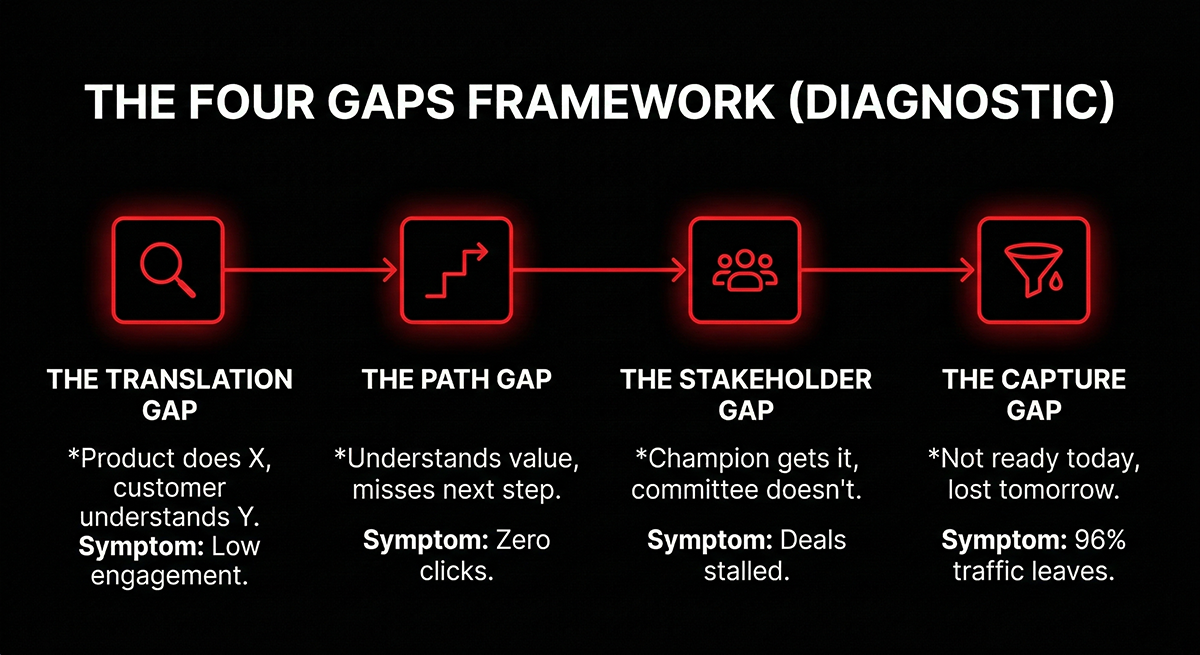
Before you work on any of these gaps, your page has to pass the technical baseline. Bad infrastructure makes everything else irrelevant.
Speed Test
A B2B site that loads in 1 second converts 3x higher than one loading in 5 seconds. Every additional second costs up to 20% of conversions.
| Metric | Fail | Pass |
|---|---|---|
| Largest Contentful Paint | Above 4 seconds | Under 2.5 seconds |
| Mobile responsiveness | Broken on mobile | Flawless (59% of web traffic is mobile) |
| Layout shift | Visible shift as page loads | Zero shift |
Tracking Test
If you only track aggregate signups and rely on client-side pixels, you're losing 20-30% of your data to ad blockers and privacy shields.
| Metric | Fail | Pass |
|---|---|---|
| Event tracking | Client-side only | Server-side configured |
| Funnel visibility | “Signups” as only metric | Drop-off points between each step |
If tracking gaps are blocking your visibility, the Analytics Mistakes article covers what to fix.
Shareability Test
Buying committees share links internally. When someone configures your pricing calculator and sends the URL to their CTO, does the link preserve what they were looking at?
| Metric | Fail | Pass |
|---|---|---|
| URL state | Resets to homepage | Captures configuration |
| Open Graph tags | Missing or generic | Rich preview with context |
| Slack/Teams preview | Blank or broken | Shows exactly what was shared |
Discoverability Test
If Google and LLMs can't read your site properly, you don't exist. You'll always be buying attention, and that's expensive.
I learned this the hard way. I built my own site on Lovable. Just before launch, I realized Lovable apps are built in React Vite, and LLMs couldn't read the content to the level I needed them to. Server-rendered pages are safer for discoverability. I spent a sleepless night moving everything to Next.js because I believed visibility was everything. If you're not discovered, you're paying for every single visitor forever.
| Metric | Fail | Pass |
|---|---|---|
| Rendering | Client-side only (React SPA, Vite) | Server-side rendering (Next.js, Nuxt, or static) |
| Googlebot visibility | Blank page or partial content | Full content visible on first load |
| LLM extractability | Content hidden in JavaScript bundles | Clean HTML with semantic structure |
| Indexation | Pages stuck in “Discovered - not indexed” | Pages indexed within days |
The Real Audit
Stop asking “is my landing page converting?”
Start asking:
- ✓Translation: Does my customer understand what my product does for them, in words they would use?
- ✓Path: Do they know exactly what to do next, at any time of day, at any stage of readiness?
- ✓Stakeholders: Can one person who gets it explain it to five people who don't?
- ✓Capture: If they're not ready today, am I still in their world tomorrow?
Fix the gaps in order. Each one unlocks the next.
Your landing page doesn't need to be prettier. It needs to be clearer.

About Judie Alvarez
Judie Alvarez is a fractional CMO who helps technical founders build landing pages that convert and GTM systems that compound. She has audited conversion funnels for Seed to Series B companies across SaaS, developer tools, and AI platforms.
Learn more →You've found the gaps. Now close them.
The 90-Day GTM Framework walks you through messaging, positioning, and conversion architecture step by step. It's where translation, path, and stakeholder alignment come together.
Related Articles

Converting Technical Trials to Paid: The 2026 Activation Fix

The Technical Founder's Guide to the First Marketing Hire