

The Technical Founder's Guide to the First Marketing Hire
How to Find a Builder (Not a Brand Architect)
You just raised your seed round. You feel the pressure to “do marketing.” You hire a shiny VP from a big company. Salesforce alumni. HubSpot pedigree. Great LinkedIn presence.
Six months later, you have a beautiful brand deck, a new logo, a $10k/month agency retainer, and zero increase in qualified leads.
You fire them. You burn six figures. You are back where you started, except now you have less runway and more doubt.
I have seen this pattern destroy early-stage companies. Not because the VP was incompetent. They were great at their job. The problem is their job was never your job.
The skills that work at a company with $50M in annual revenue and a recognized brand do not work at a company with $500k ARR and zero brand recognition. Different game. Different rules.
There is even a newer version of this trap in 2026. The AI Spammer. A marketer who buys a list of 100,000 emails, uses ChatGPT to write generic outreach, and permanently burns your domain reputation in 48 hours. Your emails land in spam. Your brand is toast. They move on to the next startup.
At Seed and Series A, you do not need “Brand Awareness.” You do not need spam at scale. You need someone who can build acquisition systems from scratch. A mechanic, not a magician.
The Wrong Hire: Why Big Company Experience Fails
I once had a conversation with a marketing executive from IKEA. He was exploring startup advisory work. Within ten minutes, he was talking about TV campaigns, brand partnerships, and awareness metrics.
His budget assumptions would have burned through an entire seed round in two months. And for what? Impressions from people who have never heard of you and have no reason to trust you.
I asked him about his last big personal purchase from an unknown brand. He thought about it. A high end aluminium bike. The shiny, expensive and fast kind of bike. The company? Direct to consumer. No TV ads. No massive brand.
What convinced him to buy? The website answered every objection he had. Clear return policy. Real customer reviews. Transparent pricing. No pressure.
That is early-stage marketing. Breaking objections, one by one, for a specific person with a specific problem. Not awareness. Not reach. Conversion.
The fact that you come from IKEA does not mean anything at a startup. IKEA has 80 years of brand recognition. They can run a billboard and people know what it means. You cannot. You do not have the power of recognition. You are starting from zero trust.
Early-stage marketing is not flashy. The more flashy the approach, the more likely you are dealing with someone who does not understand the constraints of the task.
It does not matter if you have $500k or $10M from your round. You cannot throw money at the problem because you do not know where the money will land. You do not have the data yet. You do not have the channels validated. You are still figuring out who actually buys.
The Wrong Hire: The E-commerce Playbook
Another pattern I see: founders hire marketers from e-commerce backgrounds. These people are good at what they do. They run ads. They test creatives. They optimize landing pages. They find winning combinations through brute force iteration.
E-commerce is a numbers game. You test 50 product images, find the one that converts, scale the ad spend, and print money. If a product does not work, you drop it and test the next one.
SaaS is not e-commerce.
Your product is not interchangeable. Your sales cycle is longer. Your customers need to trust you before they give you their credit card. Sometimes they need to trust you before they even book a demo.
The e-commerce playbook of “test everything, find the winner, scale” does not work when your CAC is $500 and your sales cycle is 45 days. You cannot iterate your way out of a positioning problem. You cannot A/B test your way to product-market fit.
The marketer who scaled a DTC brand selling $30 phone cases is not equipped to sell $30,000 annual contracts to CFOs.
The Profile: What a 2026 Growth Hire Actually Looks Like
At Seed and Series A, you need what I call a Growth Engineer. Someone who thinks like a developer about distribution but thinks like a human about messaging.
They know people buy from people they trust. They use systems to deliver the right message, at the right time, to the right person. They do not just “manage” channels. They build pipelines.
Here is the skill stack:
Data Reality
They understand that client-side tracking loses 20-30% of data to ad blockers, browser privacy features, and consent rejection. Research shows that ad blockers alone hide 31.5% of users from Facebook Pixel, and combined with iOS restrictions, most companies make marketing decisions on only 50-70% of their actual data.
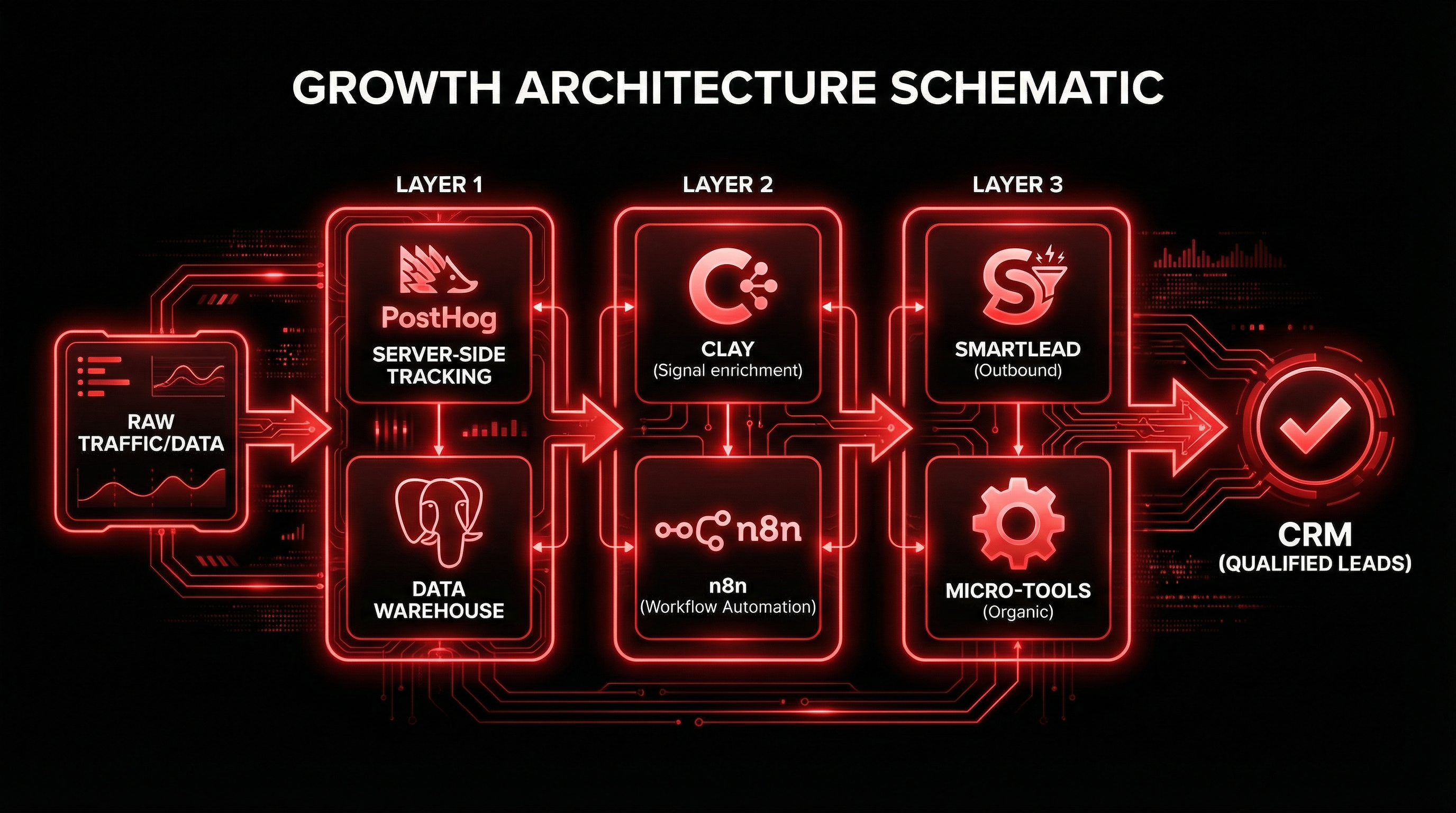
A Growth Engineer understands server-side tracking basics. They can work with your developers to implement API-level events. They do not accept dashboard numbers at face value.
Automation Independence
They can build basic data pipelines without filing engineering tickets. Zapier. Make. Clay. n8n. They know how to move leads between systems, enrich contact data, and trigger sequences without waiting three weeks for developer capacity.
This is not about replacing engineering. It is about not bothering your developers with CRM admin when they should be building product.
Engineering Partnership
When it matters, they know how to work with your engineering team. They can write a clean spec. They can explain why a particular feature would drive acquisition. They can collaborate on building micro-tools for organic traffic.
The difference between a Growth Engineer and a Growth Hacker is that the Engineer builds with the team, not around them.
Signal-Based Outbound
Generic cold email is dead. Spray-and-pray outbound burns domains and wastes time. A Growth Engineer knows how to find signals that indicate buying intent: job postings, technology choices, funding announcements, competitor mentions.
They understand compliance. They know that relevance is protection. Hyper-relevant outreach to the right person at the right time does not get marked as spam as often (it can be, but it is rare). Generic garbage to 10,000 random emails does.
Content That Compounds
They know that generic SEO content no longer wins. They focus on data-led content and engineering-as-marketing. Instead of writing “What is [Category]?” articles that compete with a million other posts, they build tools, calculators, and resources that attract links and users.
The Job Description: What to Ask For
Bad job descriptions attract wrong candidates.
Bad Job Description language:
- •“Manage brand voice”
- •“Oversee social media strategy”
- •“Coordinate PR initiatives”
- •“Build awareness campaigns”
These are Series B and C responsibilities. They assume you already have product-market fit, validated channels, and budget to burn on brand. At Seed, you have none of those.
Good 2026 Job Description language:
- ✓“Build a signal-based outbound engine with high deliverability”
- ✓“Partner with engineering to launch micro-tools for organic acquisition”
- ✓“Own tracking infrastructure and ensure data accuracy”
- ✓“Co-own CAC Payback with the founder”
- ✓“Run experiments across channels and kill what does not work within 30 days”
The language signals what you actually need: someone who builds, measures, and iterates. Not someone who manages agencies and produces slide decks.
The Interview: How to Test for Builders
Portfolios are not enough.
Previous success at a big company was usually due to the brand, not the marketer. When you have $50M in revenue and a recognized name, marketing is about optimization. When you have $500k in revenue and no name recognition, marketing is about creation.
The person who “grew” signups at a Series C company by 40% might have just inherited a working machine and turned a few knobs. That does not tell you if they can build the machine from scratch.
Here are three tests that separate builders from optimizers:
Test 1: The CSV Test
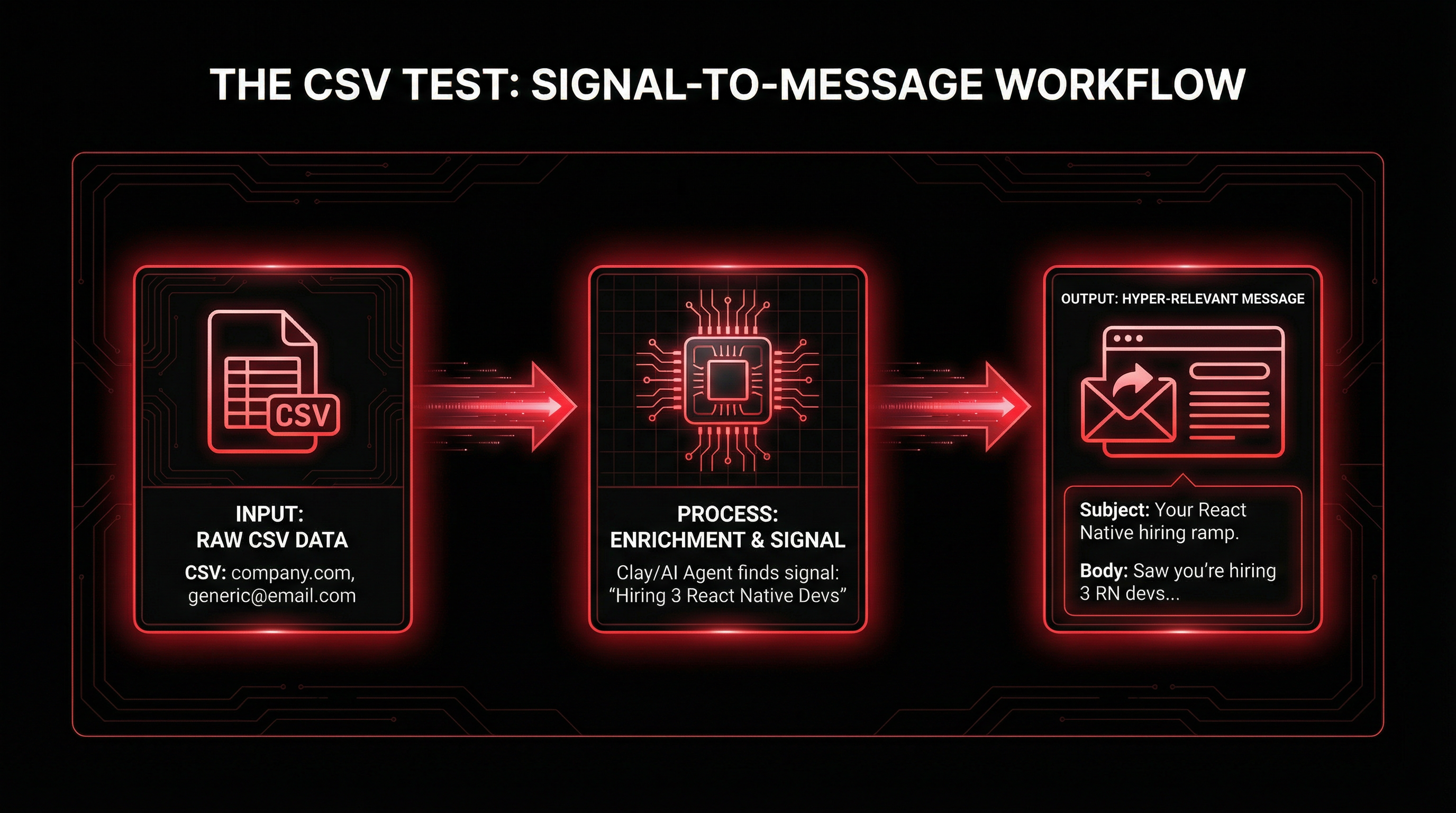
Give them a raw CSV of 500 target accounts and a link to your product. Ask: “How do you process this list, and what is the first email you send? You have 24 hours.”
Fail: They upload it to Apollo, grab standard contact info, and write a generic “Hey {{First_Name}}, I noticed your company is in [Industry]...” sequence.
Pass: They explain how they would clean the data first. They run the list through enrichment tools to find signals: recent job postings, technology stack, funding news, LinkedIn activity. They identify a pattern: “40 of these companies are actively hiring React developers, which suggests they are scaling their frontend team.” They write a hyper-relevant first line based on that signal.
The pass demonstrates systems thinking. They do not just send email. They build a process that produces relevant outreach at scale.
Test 2: The Allocation Test
Ask: “If we approve a $10,000/month marketing budget for your first quarter, how are you allocating it?”
Fail: “I would put $8k into LinkedIn Ads and $2k into Google Search. We need traffic.”
This answer reveals someone who only knows how to buy attention. LinkedIn Ads for a Seed startup with no brand recognition will produce expensive, unqualified leads. They are thinking like a big company marketer with budget to burn.
Pass: “I would spend $1,500 on infrastructure: Clay for enrichment, a tracking tool for data accuracy, basic automation. I would allocate $3,000 to hire a freelance developer to build a simple tool that solves one problem for our ICP and drives organic traffic. I would save the rest until we validate our messaging manually. Once we know what works, we pour budget into scaling it.”
This answer shows constraint-aware thinking. They understand that at Seed, you do not have enough data to know where money will land. You validate first, then scale.
Test 3: The Constraint Test
Ask: “Imagine Google and LinkedIn ban our ad accounts tomorrow. How are you acquiring our next 50 customers?”
Fail: They freeze. They suggest hiring a PR firm. They do not have an answer.
Pass: They pivot instantly. “I would double down on signal-based outbound using secondary domains with proper warmup. I would activate our existing customers for referrals with a simple program. I would identify three communities where our ICP hangs out and become a genuine contributor. I would accelerate the micro-tool roadmap for organic acquisition.”
The pass shows they do not depend on rented channels. They can build owned acquisition.
First Growth Hire Kit
The job description template and interview scorecard for your first growth hire. Copy-paste JD, six questions with pass/fail criteria, and 13-point red flag checklist.
Red Flags: When to End the Interview
Red Flag 1: The Domain Burner
They brag about sending 10,000 emails a day. They do not mention deliverability, domain warmup, or sender reputation. They do not understand that Google and Microsoft will blacklist your main company domain within a week if you spam from it.
Volume is not a strategy. Volume without infrastructure is suicide.
Red Flag 2: The Vanity Brand Architect
They want to spend their first six weeks rebranding the logo because “it looks dated.” They talk about “brand guidelines” and “visual identity” before they talk about conversion rates or customer acquisition cost.
At Seed, brand is a conversion amplifier. It is not a starting point. A beautiful brand with zero distribution is worthless. An ugly brand with a working acquisition engine can always be polished later.
If they prioritize aesthetics over revenue, they are optimizing for their portfolio, not your business.
Red Flag 3: The Agency Delegator
Their default answer to every question is “I know a great agency for that.”
Hiring specialist agencies for complex work like PR or development is smart. But if their answer to core GTM questions (How would you build outbound? How would you approach content?) is always “outsource it,” they are not a builder.
Your first marketing hire must be an individual contributor first. They must be able to do the work themselves, not just manage people who do.
Red Flag 4: The Strategy Hider
They ask for 60 days to “interview stakeholders and build a go-to-market deck” before they talk to a single customer or run a single experiment.
This is a stall tactic. It feels productive. It produces beautiful documents. It produces zero revenue.
A builder starts building. They learn by doing. They can produce a strategic document after they have data, not before.
The Execution Gap: The Translation Problem
You found a Growth Engineer who passed the CSV test. They understand systems. They can build.
Here is the problem: A builder still needs a blueprint.
You are a technical founder. You understand your product deeply. You know what it does and why it matters. But translating that into marketing language, customer segments, positioning, and campaign briefs is a different skill.
If you have to spend 15 hours a week translating your product vision into marketing sprints and reviewing outbound copy, you are no longer building product. You have become a part-time marketing manager.
Engineering sprints and marketing experiments run on different feedback loops. Code either works or it does not. Marketing produces gradual signals that require interpretation. The friction does not happen because founders cannot manage. It happens because marketing requires a specific dialect of data, psychology, and go-to-market pacing.
The Growth Engineer needs a strategic sounding board. Someone who can translate your technical product into positioning. Someone who can review their experiments and tell them if the direction is right. Someone who can help them prioritize when everything seems urgent.
This is where a strategic partner adds value. Not as a boss, not as a full-time executive bloating your cap table, but as an architect who provides the blueprint while your Growth Engineer does the building.
The vetting helps too. It takes an operator to spot a fake operator. Having someone experienced sit on your side of the table during interviews protects you from hiring another VP of Slides.
Onboarding: The First 30 Days
Startups are messy. The goal here is not to force your new hire to ship before they are ready. It is to test for a bias toward action.
Some people hide behind “discovery” and “strategy decks” for months. Others start building on day one. You want the second type, but you also want to give them room to learn your product properly.
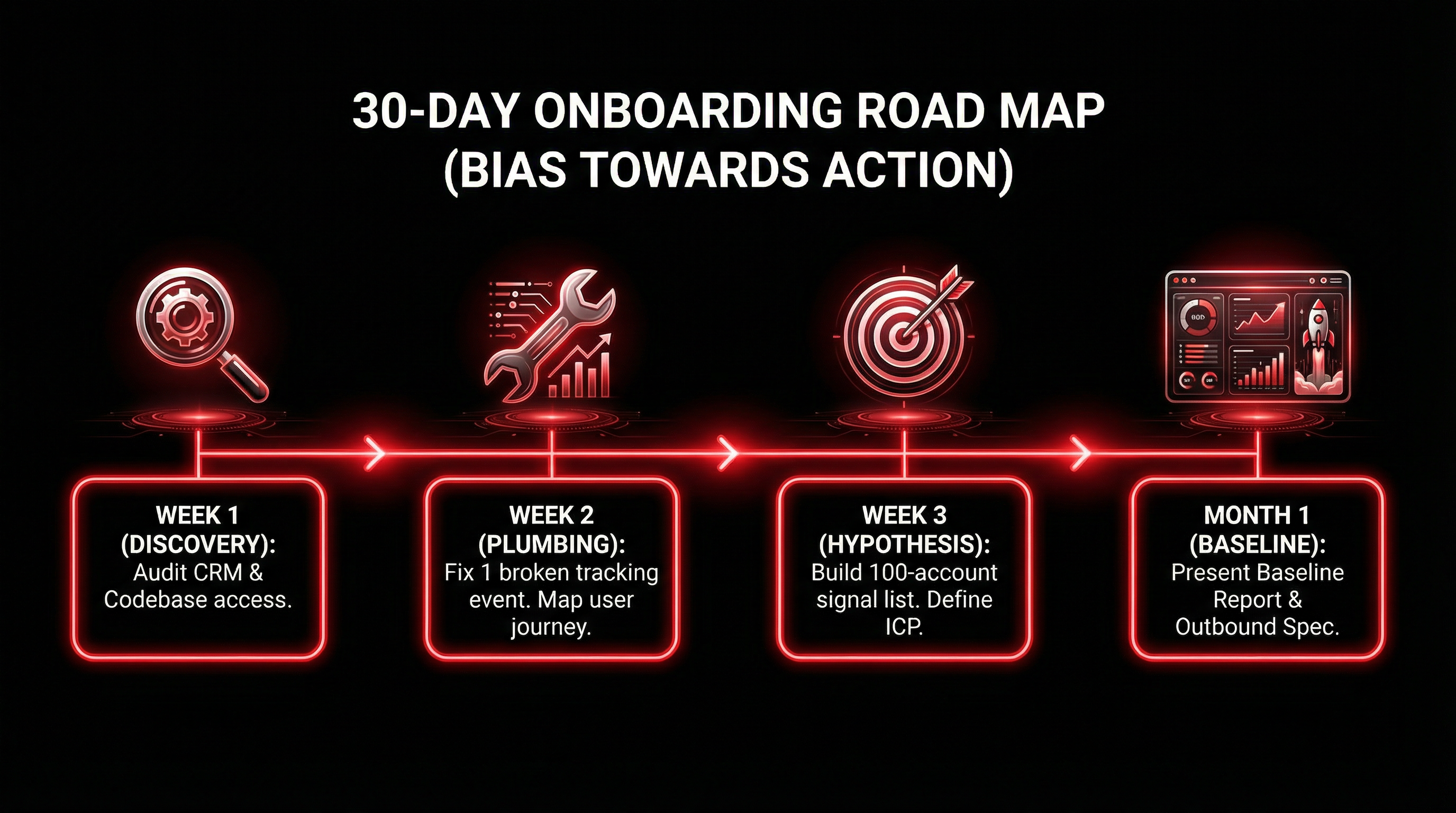
Here is a baseline timeline:
Week 1: Access and Discovery
They get access to everything: CRM, analytics, payment systems, codebase (read access), customer support tickets, sales call recordings.
Their job is to find where the problems are. What is broken in the funnel? Where does tracking drop off? Which customer segments churn fastest? What do support tickets reveal about objections? No external campaigns yet. Just learning.
Week 2: The Plumbing Audit
They should not launch outbound yet. They should be checking the pipes.
Milestone: Map the exact user journey from website click to paid user. Show the founder where tracking drops off. Find one broken thing in the CRM or analytics and fix it. This proves they are hands-on. Anyone can produce a strategy deck. Few people will dig into the data and fix a tracking bug.
Week 3: The ICP Hypothesis
They should be learning the customer.
Milestone: Build a highly targeted list of 100 accounts based on a specific signal. Bring it to your one-on-one and explain why these accounts fit your Ideal Customer Profile. Once aligned, they are cleared to launch their first outbound experiment to this list. Not 10,000 accounts. 100 accounts, handpicked, with clear reasoning.
End of Month 1: The Baseline Report
They present the current state.
Milestone: Deliver a report showing actual top-of-funnel conversion rates (based on the tracking they fixed). Present the spec for their first outbound campaign (based on the 100-account list they built). Identify the top three hypotheses they want to test in Month 2.
This proves they understand where you are starting from and have a plan to move forward. No hockey sticks. No promises. Just reality and next steps.
If they want to launch faster than this timeline, let them. Some people are ready on Day 8. But this baseline sets an expectation that protects both sides.
Compensation: What to Expect
For a Growth Engineer at Seed or early Series A (not a VP, not a director, an individual contributor who builds):
| Component | Range | Notes |
|---|---|---|
| Salary | $80k–$130k | Depends on location and experience. European markets 20-30% lower. |
| Equity | 0.25%–1% | For first marketing hire at Seed. Depends on timing and criticality. |
| Title | IC, not VP | You need someone who does the work, not manages people. |
Do not hire a VP. At Seed, you do not need a VP. You need someone who does the work, not someone who manages people who do the work. You do not have people to manage yet.
If a candidate demands VP title at a Seed company, that is a signal. They want the title more than they want the work.
Summary
Stop hiring marketers who want to paint the house. Hire marketers who can build the plumbing.
The right first marketing hire:
- ✓Understands that client-side tracking misses 20-30% of data
- ✓Can build automations without filing engineering tickets
- ✓Knows how to find buying signals, not just email addresses
- ✓Creates content that compounds instead of content that competes
- ✓Co-owns CAC Payback with you, not just “awareness metrics”
- ✓Starts building in Week 1, not after a 60-day discovery phase
The wrong first marketing hire:
- •Talks about brand awareness before talking about conversion
- •Defaults to agencies for core GTM work
- •Wants to scale ad spend before validating messaging
- •Prioritizes logo redesigns over fixing leaky funnels
- •Cannot explain their process for turning a CSV into qualified conversations
You will know you have the right person when they are building faster than you can review. When they bring you data, not decks. When they ask for forgiveness, not permission, although I am not the one to encourage recklessness, fast iteration requires some risk taking.
That is the Growth Engineer you need.

About Judie Alvarez
Judie Alvarez is a fractional CMO who helps technical founders hire their first growth team and build acquisition systems that compound. She has vetted over 200 marketing candidates for seed-stage startups.
Learn more →Get the First Growth Hire Kit
The job description template and interview scorecard for your first growth hire. Copy-paste JD, six questions with pass/fail criteria, scoring rubric, and 13-point red flag checklist.
Related Articles

The Four Gaps Killing Your Landing Page

Converting Technical Trials to Paid: The 2026 Activation Fix