

How to Get Your First 100 Users
Everyone tells you to get your first 100 users. Nobody tells you how.
It's like being told to love yourself. Great advice. Completely useless instructions. You nod along, say "yes, obviously," and then sit there wondering what you're actually supposed to do on Monday morning.
The startup world is full of this. "Talk to your customers." How? Where are they? What do you say? "Find product-market fit." What does that feel like? How do you know when you have it? "Do things that don't scale." Like what, exactly?
This is the article I wish I had when I started. No theory. No frameworks you can't actually use. Just what actually works when you have no budget, no audience, and no brand.
At this stage, distribution isn't a marketing problem. It's a product problem. And it has two phases: manual first to learn what makes people convert, then scale what you learned.
Most founders try to skip phase one. That's why they fail.
Phase 1: Manual
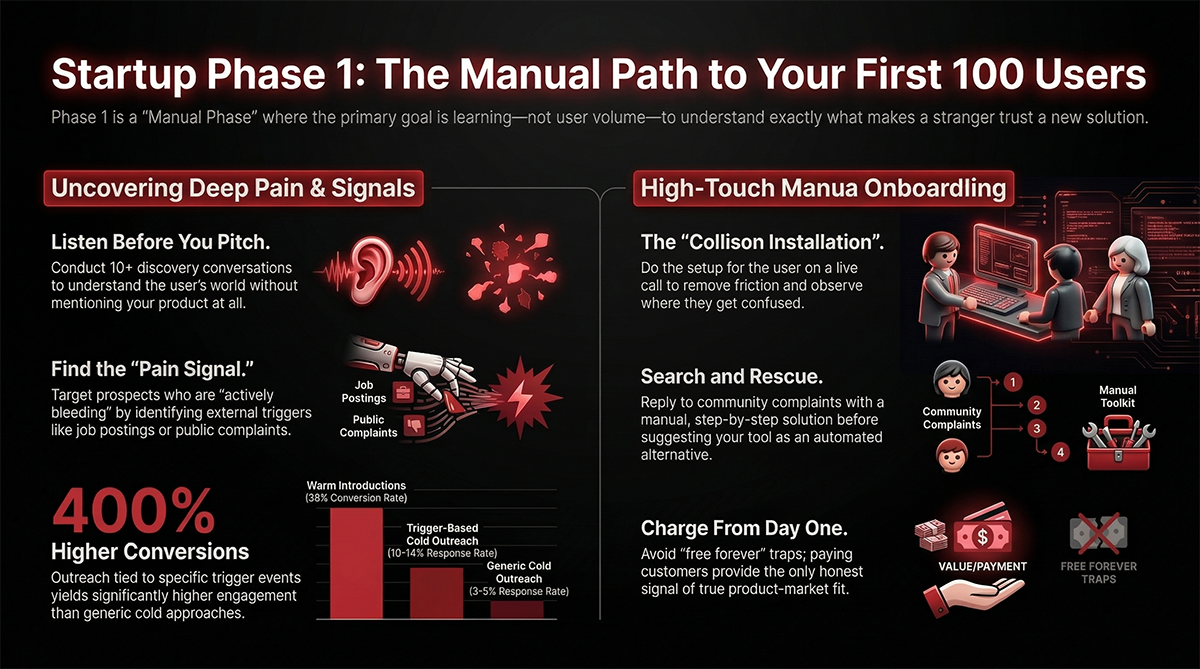
The goal of this phase is not users. It's learning.
What makes a stranger trust you enough to hand over money? What words make them lean in? What objections come up every single time? What makes them say "yes, I need this" versus "interesting, let me think about it"?
You move to phase two when you have that understanding. Not when you hit an arbitrary number.
Start with listening
Before you pitch anyone, understand their world better than they expect you to.
Set up conversations with people in your target market. Not to pitch. Not to validate your idea. To ask questions like you genuinely don't know the answers. Because you don't.
Don't mention your product. At all. Just pry for information.
What do they struggle with? What have they tried? What did they hate about those solutions? What would their life look like if the problem disappeared tomorrow? How do they currently work around it? Who else in their company cares about this problem? What would make them look good to their boss?
It's remarkable how much people will share when you show genuine curiosity about their work. They're used to being pitched. They're not used to being listened to.
The rule
At least 10 of these conversations before you form any testing theory. And this never stops. Not after you raise money. Not after you hit a million in revenue. The moment you stop asking questions like you don't know the answers, your assumptions start calcifying into blind spots.
And talk to gatekeepers, not just decision makers.
Everyone wants to get to the CEO, the VP, the person who signs the check. But gatekeepers know things decision makers don't. They know how the organization actually operates. They know what gets approved and what dies in committee. They know what the boss actually cares about versus what they say they care about in meetings. They know the politics, the budget cycles, the competing priorities.
In early sales, nothing is more valuable than information and access. Gatekeepers have both.
Sometimes getting that access looks unconventional. I once showed up with cake and Ferrero Rocher for the office team at a company I was trying to get into. Not for the decision maker. For the people around them. The assistants who controlled the calendar. The office manager who knew everyone. The people who could tell me what was actually going on inside the company and who I should really be talking to.
It worked. Not because chocolate is magic, but because attention is scarce and appreciation is rare. Everyone's trying to get past the gatekeeper. Almost nobody treats them like a person worth knowing.
Find the pain signal
The best prospects aren't people who might have a problem. They're people who are actively bleeding.
Work backwards from their dream scenario. What's the ultimate benefit your user would have? What does their life look like when the problem is completely solved?
Then figure out: what does the pain look like externally? How would you know someone is experiencing this problem right now? What signals would they be sending into the world?
At one startup, we built an email recommendation engine. The dream scenario for our customers was simple: increase basket purchases from existing users. Get people who already bought once to buy again, and to buy more.
We knew that companies trying to do this would be hiring. Specifically, they'd be looking for email marketers with ecommerce experience. That job posting was our signal. It meant they'd identified the problem, they'd allocated budget to solve it, and they were actively in the market for a solution.
So we set up alerts. Every time a job ad appeared for an ecommerce email marketer, we'd get notified. And we'd call them. Not the next week. Not when we got around to it. Immediately. Same day if possible, same hour if we could manage it.
Think about what that call looked like from their perspective. They'd just posted a job for a 70K-per-year hire. They were expecting a months-long process: post the job, screen resumes, do interviews, make an offer, wait for them to start, train them, hope they work out.
Then we'd call and say: "I saw you're hiring for email marketing. Before you commit to that, what if I told you we could get you the same results for 1K a month, starting this week?"
They were already in pain. They were already spending money trying to solve it. We weren't interrupting them with something irrelevant. We were offering a faster, cheaper solution to a problem they'd publicly announced they were trying to solve.
Research backs this up
- +Companies using trigger events see conversion rates jump by 400% compared to generic outreach
- +Reaching out within days of a relevant signal yields response rates 5-10x higher than cold approaches
- +The signal could be a job posting, a funding round, a leadership change, a public complaint, a technology change you can detect
Where to find them
Your existing network
This is always the highest-converting channel, and most founders underuse it.
Warm introductions convert at roughly 26% compared to 2-3% for cold outreach. That's not a small difference. That's a completely different game.
Former colleagues. Industry contacts. People you've worked with. People you went to school with. Friends of friends. Your investors' networks. Your advisors' networks.
Not to pressure them into buying. Most won't be your customers. But to ask: "Would you try this and give me honest feedback? Do you know anyone who has this problem? Can you introduce me to three people who might?"
Even contacts who don't convert become your first distribution channel. They mention you to someone. They forward your email. They think of you three months later when a friend complains about exactly the problem you solve.
Start with a list of everyone you know who works in or around your target market. Reach out personally. Not a mass email. Personal messages explaining what you're building and asking for their help.
Communities where they complain
Reddit. Slack groups. Discord servers. LinkedIn. Industry forums. Wherever your target market gathers to talk about their work.
The key is to search for the symptom, not the category.
If you're building project management software, don't search for "project management tools." That's people doing research. Search for "I have no idea what my team is working on" or "my project is a mess" or "I'm drowning in status updates." That's people in pain.
Set up alerts. Check these communities daily. Look for people actively expressing frustration with the exact problem you solve.
When you find them, don't immediately pitch. Help them first.
The search and rescue method
When you find someone complaining about the exact problem you solve, reply with a detailed, free, step-by-step solution. Actually help them fix it themselves. Walk them through the workaround. Share the manual process. Give them something genuinely useful.
At the very end, add a short note: "By the way, I built a tool that automates this exact process if you ever want to save the time. Happy to show you."
This works because you've demonstrated value before asking for anything. You've proven you understand their problem deeply enough to solve it for free. The product becomes a convenience, not a pitch. They're predisposed to trust you because you already helped them.
Adjacent founders
Other founders who serve your same audience but aren't competitors.
They've already warmed up that market. They've built trust with exactly the people you're trying to reach. A partnership or introduction transfers their credibility to you.
If you're building a tool for ecommerce email, talk to founders who've built tools for ecommerce analytics, or ecommerce fulfillment, or ecommerce customer support. Same customer, different problem. You can help each other.
The "who else has this problem" ask
Every conversation should end with this question. Every demo. Every onboarding call. Every customer support interaction.
"Who else do you know who has this problem?"
Make it a habit, not an afterthought. Aim for at least three warm introductions per interaction. Most people won't give you three. But if you ask everyone, the numbers compound fast. Those warm intros are 5-10x more likely to convert than any cold outreach you could do.
How to approach them
The 9:1 rule
In any community, contribute nine pieces of genuine value for every one mention of your product.
Communities are sensitive to self-promotion. Show up just to pitch and you get banned, or worse, ignored. But if you become known as someone who actually helps, people come to you.
This is grounded in how communities actually work. Research shows 90% of people are silent observers, 9% contribute occasionally, and 1% drive most of the conversation. Position yourself in that 1% of active contributors and you reach the silent 90% who are watching.
Answer questions. Share useful resources. Give detailed feedback. Help people troubleshoot problems. Build a reputation as someone who knows what they're talking about. The product mentions become natural when people already trust you.
Want the week-by-week execution plan?
The 90-Day GTM Framework walks you through how to systematize everything you're learning here, channel by channel.
Cold outreach that works
Generic blasts don't work. The average cold email reply rate is around 3-5%, and most of those replies are "no thanks" or "unsubscribe me."
But outreach tied to a specific trigger event can hit 10-14% response rates. The difference is relevance and timing.
Keep emails short. 50-75 words. Nobody reads long cold emails. They scan for relevance and delete.
Three parts:
Hook
Reference something specific to them. A recent post. A job listing. A funding announcement. A product launch. Something that proves you did your research and aren't just blasting a list. "I saw you're hiring three SDRs" hits different than "I help companies like yours."
Bridge
Connect their situation to a result you've achieved. Not features. Results. "We helped [similar company] cut their onboarding time by 40%" or "I worked with a company in your space that had the same problem and here's what happened."
Ask
Something low-friction. A 10-minute call. Their feedback on an approach. Permission to send more info. Not a 30-minute demo. Not a commitment. Just a foot in the door.
Buyers can spot an AI-generated email instantly. The generic compliments, the overly smooth transitions, the "I noticed your company is doing great things in the X space." It kills conversion. If you're going to use AI, use it for research: finding the triggers, compiling the context, identifying the right person. But write the email yourself. The writing is where you learn what resonates.
What NOT to do
At one startup I worked with, the head of sales had what he thought was a brilliant idea. The company was trying to expand into European markets. His solution: hire sales reps from Mediterranean countries. Spanish reps for Spain. Italian reps for Italy. French reps for France. Greek reps for Greece.
On paper it made sense. Native speakers who understood the culture. Existing networks in those markets. Seemed like a shortcut to European expansion.
But they didn't translate the product. The interface was still in English. They didn't create marketing materials in those languages. No case studies from local companies. No landing pages in Spanish or Italian or French. No documentation the reps could send to prospects who didn't speak English.
The reps weren't bad. They made calls. They got meetings. But the prospects couldn't evaluate the product because they couldn't read it. They couldn't share materials with their managers because everything was in English. They couldn't get internal buy-in because there was nothing in their language to show.
It didn't matter how many times I told leadership this was a disaster. They'd already committed. They pushed through for months, burning through six figures in salaries and expenses, before finally admitting it wasn't working.
This is what blasting an industry without understanding the need looks like. They assumed the problem was access. The problem was relevance. They had plenty of conversations with people who couldn't buy.
Building a B2B GTM stack?
The Minimum Viable GTM Stack for B2B Seed covers the 9 assets you need before you scale anything.
What to do with them once you have them
Manual installation
Do the setup yourself. With the customer. On a call.
Don't send them a link and hope they figure it out. Get on a screen share and walk them through it. Or better yet, do it for them while they watch.
This removes friction. Many people who would have given up during self-serve onboarding will succeed if you're there guiding them.
But more importantly, you learn. You see exactly where they get confused. You hear their questions in real-time. You notice when they hesitate, when they get frustrated, when something doesn't make sense.
And you notice when they light up. When something delights them. When they say "oh, that's cool" or "I didn't know it could do that."
Record these sessions if you can. The moments of confusion become your product roadmap. The moments of delight become your sales pitch.
The Collison Installation
Named after the Stripe founders. In the early days of Stripe, they didn't send links and hope people signed up. They'd be at a coffee meeting or a conference, someone would express interest, and they'd say "give me your laptop" and install it right there. Friction eliminated. Learning maximized.
Be the software
Before you automate everything, do it manually.
At a travel startup I worked with, the booking system would occasionally fail. Server issues, API problems, edge cases the code didn't handle. When that happened, we didn't tell the customer "sorry, try again later." We made the booking ourselves. Called the hotels directly. Used consumer booking sites if we had to. Did whatever it took to deliver what we'd promised, even if the technology wasn't cooperating.
The customers usually didn't know it was manual. They just knew their booking came through. But we learned every edge case, every failure mode, every situation the product needed to handle that we hadn't anticipated.
This is normal at early stage. The product is held together with tape and hope. You make up for its shortcomings with manual effort until you've learned enough to build it properly.
Direct access
Give your early users your phone number. A private Slack channel. Your direct email, not support@company.com.
Respond in minutes, not days. Fix bugs the same day they're reported. Follow up the next morning to make sure the fix worked.
This builds loyalty that no automated email sequence can match. Your early users will forgive a lot of rough edges if they feel like you actually care about their experience.
Proactive check-ins
Don't wait for complaints. Silence usually means they've given up, not that everything is fine.
Reach out actively. "How's it going? Where are you getting stuck?" Do this within the first few days, before they've had time to churn.
If they haven't hit a key milestone (first successful use of the core feature, first value delivered), reach out immediately. Find out what's blocking them and fix it.
Charge something
Free users don't give you real signals.
They request features they'd never pay for. They complain about things that don't actually matter to paying customers. They overwhelm your support without contributing to your runway. They give you false confidence about demand that evaporates when you introduce pricing.
Charge something. Even a small amount. Even a "pay what you want" model during the earliest phase.
The act of paying changes the relationship. Paying customers give you honest feedback about what's actually worth money. They tell you what would make them pay more. They push back on pricing in ways that teach you what they value.
Free trials are fine. Free forever is a trap.
How to know if they're getting value
Ask them directly: "How would you feel if you could no longer use this product?"
- -Very disappointed
- -Somewhat disappointed
- -Not disappointed
The Sean Ellis Test
This is the closest thing to a reliable measure of product-market fit. If 40% or more say "very disappointed," you likely have something people genuinely need. Below 40%, you're still building on hope.
Survey people who have actually used your product at least twice in the past two weeks. Not people who signed up and never came back. You need at least 30-40 responses before the data becomes directionally useful.
If you're below 40%, focus on understanding why the "very disappointed" people love it and what's holding the "somewhat disappointed" people back. The answer is usually in there.
How to know you're ready for phase 2
Signs you've learned enough:
- ✓Users return unprompted. Without reminders, without nudges, they come back and use the product again.
- ✓You can predict what will make someone convert. You know which words land, which objections come up, which features matter.
- ✓Retention holds past the first week. People don't just try it. They stick.
- ✓People are willing to pay full price. Not discounts, not lifetime deals, not "just for the first 10 users." Actual pricing.
- ✓You've stopped being surprised by what works. The patterns are clear.
Signs you're not ready:
- ✗High churn after first week. They try it and leave.
- ✗Every sale feels like a grind. You have to push hard to close anyone.
- ✗You're still surprised by what works. Still running experiments on basic positioning.
- ✗Users keep asking for features outside your vision. They want something you're not building.
- ✗Your understanding of the market hasn't deepened since day one. You're still operating on your original assumptions.
The thing founders skip most often: listening. The moment you think you understand your market, you start missing the changes.
Phase 2: Scale
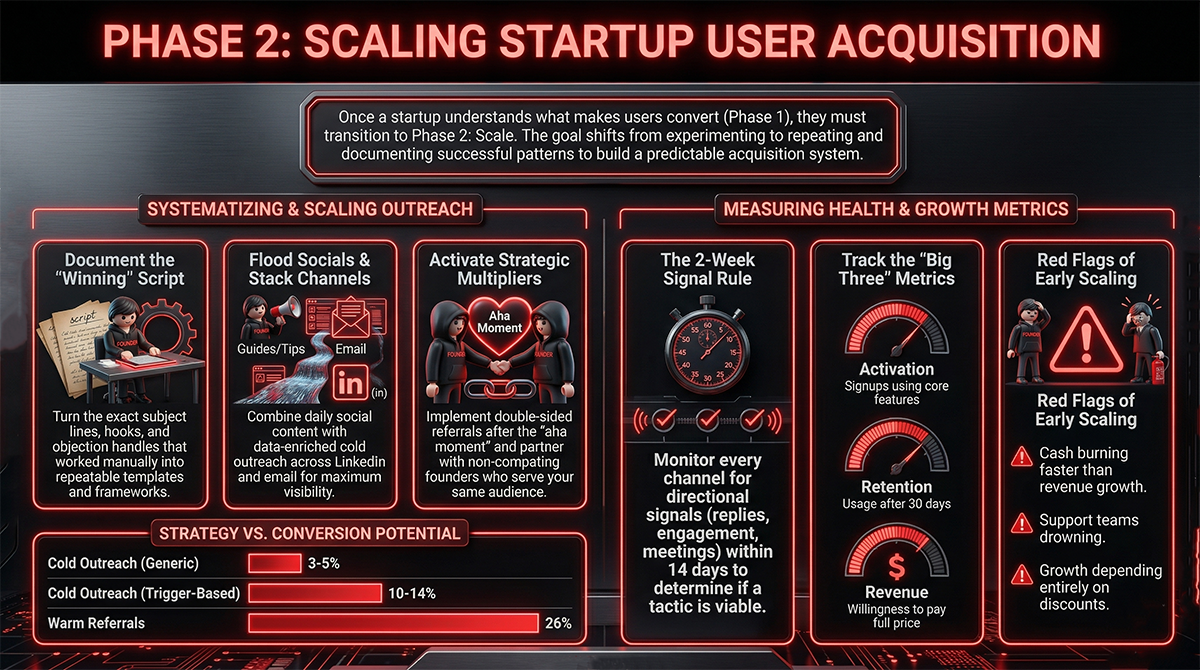
The goal shifts. Stop experimenting. Start repeating.
You've figured out what works. Now you document it, systematize it, and do more of it.
Systematize what worked
Write down exactly what you said to convert your first users.
Which message got replies? What was the exact subject line? What was the hook that made them respond?
Which channel produced paying customers, not just signups? LinkedIn DMs might generate lots of conversations but if nobody converts, that's a dead end. Cold email might feel harder but if it produces actual revenue, that's where you focus.
Which objection came up every time, and how did you handle it? Write down the exact words that worked.
Create templates based on what actually worked, not what sounds good in theory. If a three-sentence email about a specific problem got 20% reply rates, that exact framework becomes your baseline. Don't get creative. Get repeatable.
This isn't complicated. It's just documentation. But most founders skip it. They think they'll remember. Then they hire someone and realize they can't transfer what they learned because it was never written down.
Scale outreach
Flood socials with relevant content
At The Hub, we posted daily. Sometimes multiple times a day.
Job openings from startups in our network. Rankings of top companies hiring. Guides on how to get hired at startups. Tips for interview preparation. Behind-the-scenes looks at what different roles actually do. Everything a job seeker in the startup world might want to know.
We did a massive SEO exercise alongside this. Every job title someone might search for got a landing page. Every company in our database had a page. Every guide we wrote was structured to rank. We flooded our space with relevant content until it was nearly impossible to search for anything in our niche without finding us.
The goal isn't to go viral. It's to be everywhere your audience is looking. When someone searches for something in your space, you show up. When they're scrolling LinkedIn, you show up. When they ask a friend for resources, your name comes up because everyone's seen you.
This compounds slowly and then very quickly. The first few months feel like shouting into the void. Then suddenly you're the default answer for a certain type of question.
Cold outreach at volume
Now that you know the message works, you can scale it.
Use data enrichment tools to find signals. Funding rounds, hiring bursts, technology changes, leadership moves. Set up alerts for the triggers that correlated with your best conversions in phase one.
Email alone is weaker than it used to be. Stack channels: email, then LinkedIn, then email again. The combination outperforms any single channel.
But only do this after you've proven the message works manually. Automating bad outreach just means you're annoying more people faster.
Double-sided referrals
The best time to ask for a referral is right after someone gets value from your product. Not when they sign up. After they've succeeded at something. After they've had the "aha moment."
Reward both sides. The referrer gets something. The new user gets something. It stops feeling like a favor and starts feeling like a gift.
The best SaaS companies eventually get 20-50% of new customers through referrals and word of mouth. But you can't automate trust. The referral program comes later, to amplify something that was already happening organically.
If nobody's referring you without a program, a program won't fix it. If people are already referring you, a program accelerates it.
Partnerships
Find companies that serve your same audience but aren't competitors. Co-marketing, integrations, shared distribution.
This is harder to set up than ads. It requires relationships, alignment, and mutual benefit. But it compounds. One good partnership can be worth months of cold outreach.
How to know it's working
Track what matters. Not vanity metrics.
- +Activation: What percentage of signups actually do the thing your product exists to do? If people sign up and never use the core feature, you have an onboarding problem or a targeting problem.
- +Retention: Are they still using it after 7 days? 30 days? If they try it once and never come back, you're not delivering enough value.
- +Revenue: Are they paying? Are they expanding their usage? Are they upgrading?
If outreach generates traffic but nobody activates, the channel isn't working. If people sign up but churn in a week, you scaled too early.
The 2-week rule
Some channels take longer than others to work. SEO takes months. Ads can produce data in days. Community building takes somewhere in between.
But within two weeks of focused effort on any channel, you should see some directional signal. Not necessarily conversions. But indicators: replies, engagement, meetings, interest.
If you're seeing nothing after iteration, either the channel is wrong for your audience or your message is wrong for the channel. Test both before you abandon, but don't keep pouring resources into something that shows no signs of life.
Know the rules of the channel. Google needs around 30 quality articles before it considers you worth distributing. You can accelerate with video content and niche topics, but you shouldn't get frustrated at article three. Some channels require upfront investment before they pay off. Others should show signal immediately. Know which is which.
How to know it's not working
Signs you scaled too early:
- ✗Cash is burning faster even as revenue grows. You're spending more to acquire each customer than they're worth.
- ✗Support can't keep up. Quality is degrading. Your team is drowning.
- ✗Growth depends entirely on discounts. At full price, nobody buys.
Signs the channel is dead:
- ✗Engagement stays high but conversions drop. People are clicking but not buying. The audience has shifted or saturated.
- ✗Cost per acquisition keeps rising past your payback threshold. The economics no longer work.
- ✗What worked six months ago doesn't work now. The playbook is stale.
When to go back to manual
- -Growth stalls and you don't know why
- -You're entering a new market segment
- -Something big changed in your industry
- -The patterns that used to be reliable aren't anymore
Don't be too proud to go back to phase one. Sometimes the market shifted and your assumptions are outdated. Go talk to people again. Listen with fresh ears. Figure out what changed.
The first 100 users aren't a milestone. They're your education.
This phase is supposed to be inefficient. You're doing things that don't scale because that's the only way to learn what actually works.
Manual installation on every customer call. Booking hotels by hand when the system crashes. Showing up with chocolate for the people everyone else ignores. Searching Reddit at midnight for people complaining about the exact problem you solve.
None of this scales. All of it teaches you something.
The first 100 users don't validate your idea. They teach you how to sell it. Everything after that is just scale.

About Judie Alvarez
Judie Alvarez is a fractional CMO who has helped founders across B2B SaaS, D2C, and marketplace businesses get their first paying customers. She has built early-stage GTM systems from zero across multiple industries.
Learn more →You've Got the Users. Now Build the Machine.
The 90-Day GTM Framework walks you through how to systematize what worked, week by week, channel by channel.
Related Articles

The Technical Founder's Guide to the First Marketing Hire

The B2B SaaS Growth Operating System: A 90-Day GTM Framework (With Templates)