

How to Sell to Companies as a New Startup (Without Case Studies or Brand)
TL;DR
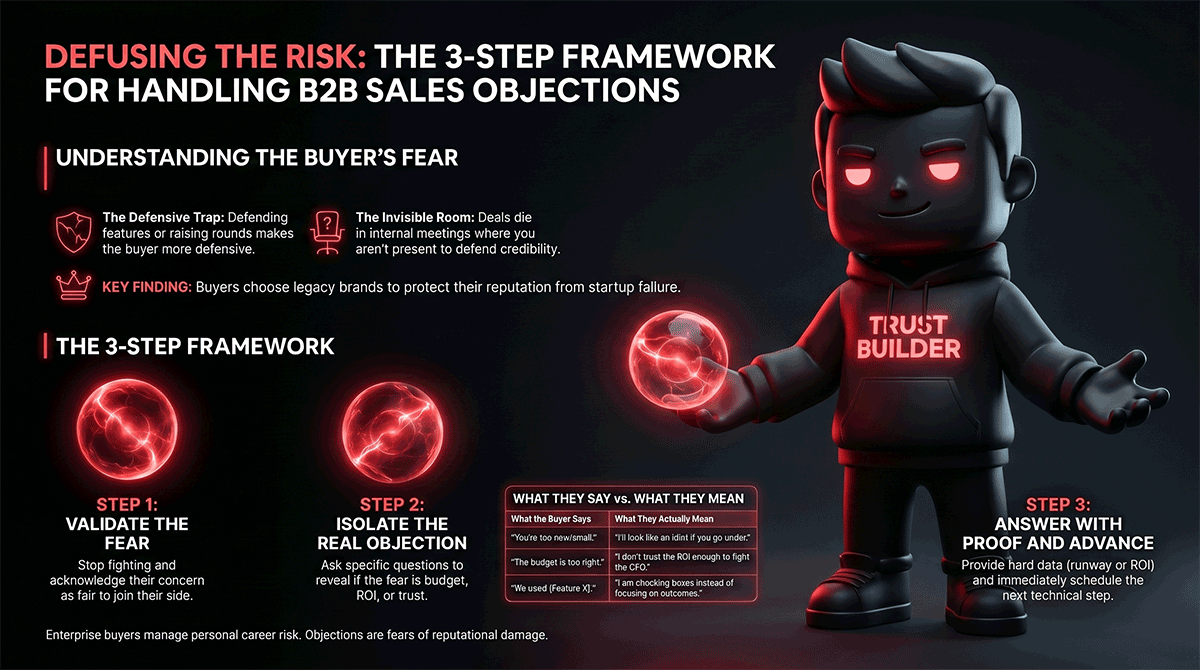
Companies don't buy from unknown startups because the person making the decision could lose their job if you fail. If they pick Microsoft and Microsoft screws up, that's Microsoft's problem. If they trust you, pick you and you go under, they look like idiots and it hinders their job. If you want to stop trying to convince them your product is better and start proving you won't destroy their career, or better make them look like a superstar, listen up. I'm going to give you the tools to figure out what they're actually scared of, show them proof, and give them everything they need to defend choosing you to their boss. I call it the Trust Pack, and it's the difference between deals that close and deals that die in a room you're never invited to.
Why Companies Won't Buy from Brand New Startups
Last year, I was validating a startup idea with a founder. He had a solid concept, a real problem and tech that could work, the issue was he could only sell it to an enterprise.
So I set up a meeting with a senior procurement leader at a major cosmetics company. She immediately warned us: great concept but too much risk for us to buy into it.
See, the thing is, many large companies have a rule. They won't work with vendors where more than 40% of that vendor's company value comes from their contract, because you are too much risk for them. If you're brand new and they're your first customer, you're 100% dependent on them. This isn't one company being difficult, it is them protecting themselves.
That's why investors obsess about your problem being so massive that they need you more than they fear you. And you should too because this is how you open doors.
This doesn't only apply to enterprises. In SMEs the damage can be even bigger because employees can't hide behind large numbers and trusting you can cause real damage to the business.
When someone evaluates you, they're not thinking about innovation; they are thinking risk. They're thinking about what happens if you go under in 12 months.
If they picked Oracle, they can hide behind the power of their brand. If they picked you, the company that nobody knows, they get blamed.
The buyer isn't risking company money. They're risking their reputation and, in some cases, their career. And between you and them, well... you get the picture.
This is startup trust risk. It's not about your product being bad. It's the perceived career and operational risk a buyer takes when they choose an unknown vendor.
Every deal you lose to "no decision" is this playing out.
Now, if that wasn't enough we have an added complication, because not only do you need to convince humans, but in 2026 20% of B2B deals involve AI agents to discover suppliers, check compliance, negotiate. If your website information is locked in PDFs or behind forms, the AI agent cannot read it. To the AI, you do not exist. You will never appear on the shortlist.
So you're invisible to the machines and you're a career risk to the humans.
That's the problem.
Why Defending Your Startup Makes It Worse
When buyers say "you're too new," most founders do the worst possible thing. They defend.
- •"Actually, we just raised a big round."
- •"But our features are better than the competitor."
- •"We can give you a discount."
This makes it worse. The buyer gets defensive. The call turns into an argument. The objection gets stronger, not weaker.
Here's what's happening. The objection they say out loud isn't the fear they actually have.
A budget objection might be a trust problem. A timing objection might be them not seeing urgency. If you answer what they said instead of what they mean, the real fear sits there untouched and the deal dies quietly.
Most founders think the problem is the product. They build comparison charts showing how their software is faster, cheaper, better. They pitch features. They walk through architecture.
None of this matters if the buyer doesn't believe you'll exist in 12 months.
When you pitch features, you're answering a question they didn't ask. The buyer is thinking, "Will this company be around next year?" You're saying, "Our algorithm is superior."
Feature superiority is invisible to someone who doesn't trust you. You're solving the wrong problem.
Want a repeatable path to your first million?
That's exactly what the Strategic Sprint builds: positioning that lands, a narrative investors get, and a 90-day roadmap. Two weeks, in person.
The 3-Step Framework for Handling Every Objection
An objection is not a rejection. It's them telling you exactly what they need to hear before they can say yes. The average enterprise deal hits four to six big objections. If you wing it, you lose.
Here's the framework. Three steps. This is the most reliable framework I've seen across deals.
Step 1: Validate the Fear
When a buyer tells you you're too new, too small, too risky, your gut says fight back. Don't.
The second you get defensive, the call becomes an argument. Their position hardens. You've lost.
Instead, shut up. Let them finish. Then say out loud that their concern makes sense.
Script
"That's a completely fair concern. Choosing a newer vendor carries real risk, and it would be irresponsible of you not to question that before bringing this to your team."
You're not agreeing to lose the deal. You're joining them on the same side of the table. Once you do that, the conversation shifts from a fight to a collaboration.
Step 2: Isolate the Real Objection
Here's the thing most founders miss. What they say is almost never what they mean.
"We don't have budget" might mean "I don't trust you enough to fight for budget." "The timing isn't right" might mean "I don't see why this can't wait." If you answer what they said instead of what they meant, the real fear stays there and the deal dies anyway.
You need to ask a question that forces them to get specific.
Script
"When you say the budget is tight, does that mean the money is gone for this quarter across all departments, or does it mean the ROI we're showing doesn't justify moving money around?"
That takes a vague objection and turns it into something you can actually solve.
Step 3: Answer with Proof and Advance
Once you know the real objection, answer it with proof. Not features. Not promises. Proof.
- •A risk concern gets answered with data. Runway, growth rate, guarantees.
- •A feature concern gets answered with a business outcome.
- •A budget concern gets answered with ROI math.
Then immediately ask for the next step. Don't let the deal sit.
Script
"Based on what we just discussed, can we set up a technical review with your team next week?"
If you don't move it forward right there, the conversation becomes theoretical and theoretical conversations don't close.
The Six Objections You'll Get (With Scripts)
These aren't hypothetical. These are the exact objections you will hear. Here's how to handle each one.
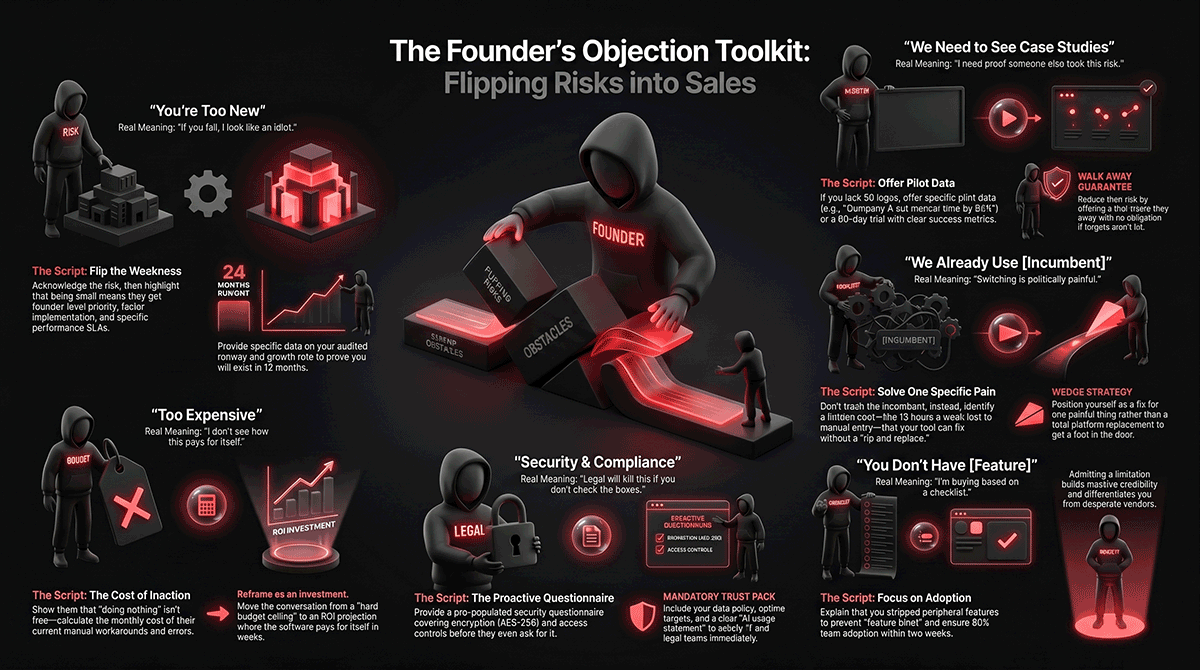
How to Handle "You're Too New"
What they're really saying
"If you fail, I'm the idiot who picked the unknown startup. That's my reputation, my next promotion, maybe my position on the line."
The script
"That's a really responsible question. Vendor viability is a real risk, and being newer means we have a higher bar to clear. Here's where we actually stand: we have 24 months of audited runway, we're growing at [X%], and we have zero churn in our enterprise segment.
Here's what you get that you won't get from [big vendor]: direct access to the founders, engineering priority when you need something built, and implementation speed that large companies can't match because they have 10,000 other clients ahead of you. Our early clients are our entire reputation. We literally can't afford for you to fail.
If we give you a 90-day implementation guarantee with specific performance SLAs, would that give you what you need to move this to a technical review?"
You're not pretending you're a big company. You're flipping it. Being small means they get founder attention, speed, and a vendor who will move heaven and earth to make them succeed because your survival depends on it.
How to Handle "We Need to See Case Studies/References"
What they're really saying
"I need proof someone else took this risk and didn't end up looking stupid."
Not having case studies is completely normal at early stage. This is where partnerships become your best friend. If their need is bigger than their fear, you can flip this around.
The script
"That's completely fair. Social proof matters when you're taking a recommendation to your team. Here's what we can give you right now.
We don't have 50 logos. What we do have is pilot data from [number] companies in your space. [Company A] cut manual processing time by 34% in the first 45 days. [Company B] deployed to 500 users in two weeks with zero downtime.
I can set up reference calls with them this week. Or we can structure a 60-day pilot with clear success metrics. If we hit them, you've got your case study. If we don't, you walk away. No obligation. Which works better for you?"
What I've done many times is call companies and ask if they'll collaborate for free or at a reduced rate in exchange for being a beta partner. Medium-sized companies are way more open to this if they have a real pain, and they like the exposure too. Build those partnerships before you need them.
How to Handle "We Already Use [Incumbent]"
What they're really saying
"Switching is painful, political, and I don't want to own that mess."
The script
"That's good that you have infrastructure in place. I'm not suggesting you rip everything out and start over.
What we hear from teams using [Incumbent] is that while it's a solid system, they're losing about 15 hours a week to manual data entry, integration issues, and workarounds for things the platform doesn't do well. If you could fix one specific pain point in your current setup without disrupting everything else, what would it be?"
You're not selling a platform replacement. You're selling a fix to one painful thing. Once you're inside and proving value on that one thing, the conversation grows on its own.
How to Handle "Too Expensive"
What they're really saying
"I don't see how this pays for itself."
70% of "budget" objections aren't about budget at all. They're about value. The buyer is comparing your price to the cost of doing nothing, and they think doing nothing is free. It's not.
The script
"I get that budgets are tight right now. Quick question: when you say it's too expensive, are we comparing against a hard budget ceiling, or against the return you're expecting to see?
The reason I ask is that doing nothing usually isn't free. Based on what you told me earlier, your team is spending roughly $15,000 a month on manual workarounds and error fixing. If we eliminate 80% of that, the software pays for itself in about six weeks.
Can we run a quick ROI projection using your actual numbers and see if the math works?"
You're making the cost of inaction visible. They thought doing nothing was free. You just showed them it's costing $15,000 a month. Now you're not an expense. You're the thing that stops the bleeding. And you're giving the internal champion the exact economic argument they need to go fight the CFO for budget.
How to Handle "You Don't Have [Feature]"
What they're really saying
"I'm comparing you against a checklist instead of thinking about what I actually need."
The script
"You're right. We don't have [feature], and I want to be upfront about why.
When we built this, our data showed that 80% of enterprise software fails because of feature bloat and low adoption. Teams get overwhelmed by complex interfaces they never actually use. So we stripped out the peripheral stuff and focused on doing [core outcome] really well.
If [feature] is a regulatory requirement for you, we might not be the right fit and I'd rather tell you that now. But if what you actually need is [outcome] with 90% team adoption in two weeks, that's exactly where we win. Which one matters more for what you're trying to do this quarter?"
The honesty is the weapon here. When you say "we might not be the right fit," you stop sounding like every other desperate vendor and start sounding like someone they can trust.
How to Handle Security and Compliance Concerns
What they're really saying
"Our legal and security team will kill this deal if you don't check the right boxes."
Most companies will send you the dreaded questionnaires. They know most startups can't afford every certification. They started with that assumption. The point isn't to have everything, it's to show you can mitigate their risk.
The script
"Security and compliance aren't things you can cut corners on, and I wouldn't want you to. Here's exactly where we stand.
We've already pre-populated the standard security and compliance questionnaire so your team doesn't have to chase us for answers. It covers encryption, access controls, data handling, incident response, everything your legal and security teams are going to ask. I can send it over today with the contract.
On top of that, here's what we have in place right now: AES-256 encryption at rest, TLS 1.3 in transit, mandatory SSO and MFA for all users, and quarterly penetration testing by [firm]. Nobody on our team accesses customer data in production without explicit approval and a full audit log.
I can sit down with your security and legal teams this week and walk through any gaps line by line. If there's something specific that's a blocker, let's talk about it directly. When can we get your IT and legal on a call?"
Most early-stage startups can't afford SOC 2 or the equivalent certifications. The buyers know this. They're not expecting you to have it. What they are expecting is that you take it seriously. A pre-populated compliance questionnaire that's ready to go before they even ask shows you understand how they buy and saves them weeks of back and forth. That alone puts you ahead of 90% of startups they talk to.
I've seen founders navigate this many times. A friend of mine built her entire startup around the pain of doing those security questionnaires. She created a full compliance documentation pack that companies could review before the first sales call. It saved months in the sales process and became her competitive advantage. Have your compliance documentation ready to go before you need it.
Get the 90-Day GTM Toolkit
8 templates including the ICP Definition Worksheet, Experiment Card, and Channel Decision Matrix: the exact tools to build the GTM foundation that makes these scripts land.
What to Build Before You Need It: The Trust Pack
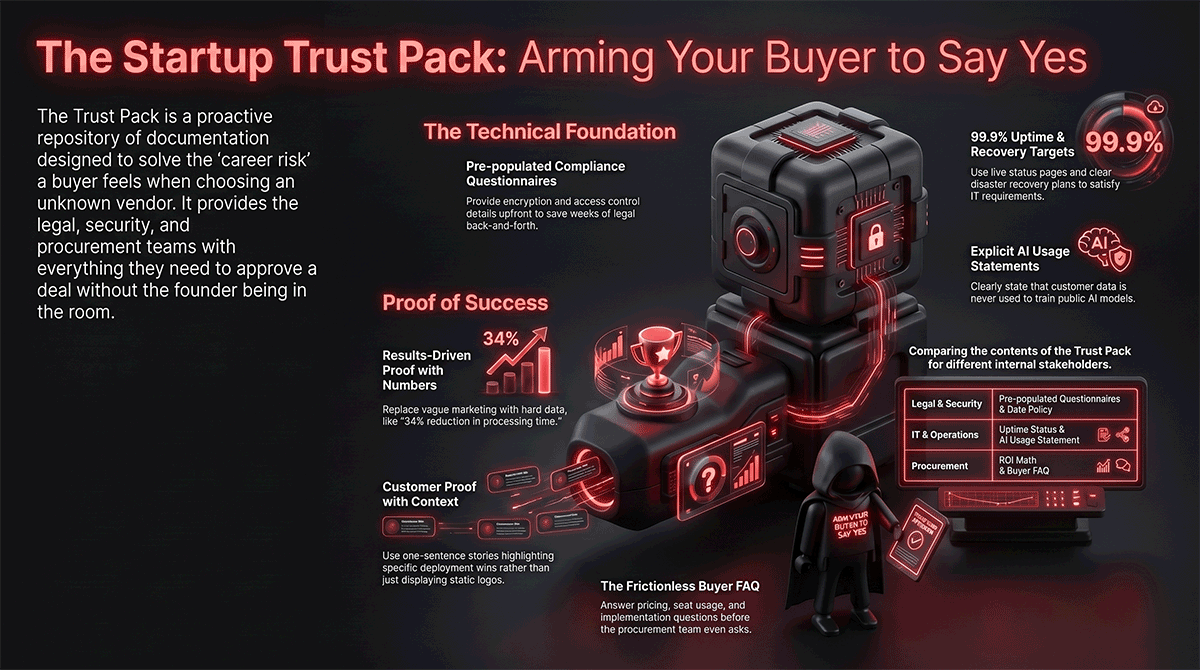
A Trust Pack is a single place where you put every document the procurement team is going to ask for. Security details, compliance status, uptime data, data policies, proof of results. All of it. Ungated. Ready to send.
Here's the problem it solves. You handle the objection on the call. Great. The buyer is convinced. Then they have to go defend choosing you to legal, security, procurement, and their boss. If they don't have the ammunition, the deal dies in that room and you never even know it happened.
The Trust Pack does their homework for them. It shows you understand how enterprises buy and you're ready for it.
What goes in it
Security
AES-256 encryption at rest, TLS 1.3 in transit, SSO and MFA support, how often you run vulnerability scans. Put "We never sell customer data" in plain text. Legal teams want to see it said directly.
Compliance questionnaire
Most buyers will send you a security questionnaire. Don't wait for it. Have your own pre-populated version ready to send with the contract. Cover encryption, access controls, data handling, incident response, disaster recovery. If you do have certifications, link them. If you don't, the pre-populated questionnaire shows you take it seriously and saves everyone weeks.
Uptime and recovery
99.9% uptime target linked to a live status page. How often you back up data. What happens if everything goes down and how fast you recover. These are the questions the IT team will ask.
Data policy
What happens to their data if they stop being your customer. Which of your engineers can see their data and under what conditions. Where the data is physically stored. If you have European clients, data residency matters a lot.
AI usage statement
This is non-negotiable in 2026. Companies are terrified of their data ending up in public AI models. Say clearly: do you train models on customer data? Which LLMs power your features? What stops their data from mixing with someone else's? If you can't answer these questions clearly, enterprise deals are going to be very hard.
Proof with numbers
Kill the marketing language. "We improve efficiency" means nothing. "Cohort analysis shows a 34% reduction in manual processing time within the first 45 days" means everything. Procurement teams buy numbers.
Customer proof with context
Logos on a page are useless. Nobody believes them. Instead: "Series B fintech deployed to 2,000 users in 14 days with zero downtime." One sentence that tells a specific story. And make it clear how prospects can get on a reference call.
Buyer FAQ
How does pricing work (per seat, per usage, flat rate)? How long does implementation take? What do they need from their IT team to get started? Answer these before they ask.
Where to put it
A dedicated URL. Ungated. No email required. Structured so both humans and AI agents can read it. When you hand a buyer a Trust Pack, you're saying: "We know how this works. We've done the work. Here's everything your team needs." That changes the conversation from fighting for credibility to discussing when you start.
How to Make Sure AI Agents Can Find You
By 2026, 20% of B2B sellers face AI-led negotiations and 61% of purchase influencers use private AI tools to research buying decisions. If your information is locked in PDFs, gated behind forms, or buried in JavaScript-heavy pages, AI agents can't read it. You won't show up on any shortlist.
This isn't about keyword stuffing. That's old SEO. This is about making your information readable by machines.
Three things you need to do
- 1.
Use structured data
Implement JSON-LD schema markup on your site. SoftwareApplication schema for your product, FAQPage schema for Q&A sections, BreadcrumbList for your site structure. This is the language machines speak. If you don't speak it, they skip you.
- 2.
Put the answer first
After every heading on your site, put a direct answer in 40-60 words before you go into detail. AI models read top-down. They grab the first clear answer they find. If your answer is buried in paragraph four, the AI pulls from someone else's site.
- 3.
Make the relationships clear
Clearly state what you are, what problem you solve, who it's for, and what you integrate with. LLMs don't read keywords. They read how things connect to each other. If those connections aren't obvious, the AI doesn't understand what you do and can't recommend you.
This isn't optional anymore. If you're invisible to AI agents, you're missing a growing chunk of how companies find vendors. And that chunk is only getting bigger.
The Bottom Line
If you're losing deals, it's rarely because your product isn't good enough. It's because the buyer can't afford to trust you yet.
Fix that, and everything else gets easier.
Stop defending. Start handling objections with the 3-step framework. Build your Trust Pack before you need it. And make sure the machines can find you.
Without a Trust Pack, deals don't die on the call. They die in the internal meeting you're never invited to.
Give your buyer the ammunition to fight for you when you're not in the room.
If you're earlier than this and still figuring out whether people actually want what you're building, start here with how to get your first 100 customers. And if your website is getting traffic but nobody is converting, the problem might be your positioning, messaging, or path.
Frequently Asked Questions
How do brand-new startups overcome buyer risk aversion?
By shifting from pitching features to fixing the buyer's fear. Use the 3-step objection framework: validate their concern, figure out what they're actually worried about underneath the surface objection, and answer with proof. Then build a Trust Pack so the buyer can defend choosing you to their legal, security, and procurement teams without you being in the room.
What should you do when a buyer says "you're too new"?
First, don't defend. Validate that their concern is real. Then show your operational stability with specific numbers: runway, growth rate, churn. Flip the weakness by pointing out they get founder-level attention and speed that big vendors can't match. Offer a 90-day performance guarantee with specific SLAs to take the risk off them.
How do you handle the "we need case studies" objection?
Don't apologize for being early stage. Offer what you do have: pilot data with real numbers, reference calls with beta customers, and a structured trial with clear success metrics. Propose a 60-day pilot where if you hit the targets, they have their case study. If you don't, they walk away. Put the risk on yourself.
Why do buyers choose legacy software over better startup solutions?
Because enterprise buying is about career safety, not innovation. The person who chose the big established vendor is protected if things go wrong. The person who chose the unknown startup gets blamed. To win, you have to show the hidden costs of sticking with the incumbent: the hours wasted on manual workarounds, the slow deployment, the expensive consultants needed to maintain bloated systems.
What is a Trust Pack in B2B sales?
It's a single, ungated repository with everything the procurement team will ask for: security details, compliance status, uptime data, data policies, AI usage statement, proof of results with real numbers, customer proof with context, and a buyer FAQ covering pricing, implementation, and IT requirements. It does the buying committee's risk assessment work for them before they even ask.
How should you handle the "too expensive" objection?
70% of the time it's not about money. It's about value. Ask whether they're hitting a hard budget ceiling or whether the ROI doesn't justify it yet. Then show the cost of doing nothing: calculate what their manual process is actually costing them per month. Reframe from "expense" to "investment that pays for itself in six weeks" using their own numbers.
How do you handle security and compliance objections?
Most early-stage startups can't afford full certifications like SOC 2. Buyers know this. What they want to see is that you take it seriously. Have a pre-populated compliance questionnaire ready to send before they ask. Detail what you already have in place: encryption, access controls, penetration testing. Offer to walk through it with their security and legal teams. Being prepared puts you ahead of 90% of startups they talk to.
How do AI agents impact B2B software buying?
AI agents are now doing vendor discovery, compliance checking, and shortlisting before any human talks to you. If your website information is in PDFs, behind forms, or in unstructured pages, the AI can't read it and you don't exist in their process. Fix it with structured data markup, answer-first content, and clear descriptions of what you do, who you serve, and what you integrate with.
Still losing deals you should be winning?
Book 20 minutes. We'll identify exactly where the deal is dying and what to fix first.

About Judie Alvarez
Judie Alvarez is a fractional CMO helping Seed to Series A startups build distribution that compounds. She's driven +208% traffic growth, 60% CAC reductions, and helped secure €8M+ valuations through data-driven growth strategies.
Learn more →