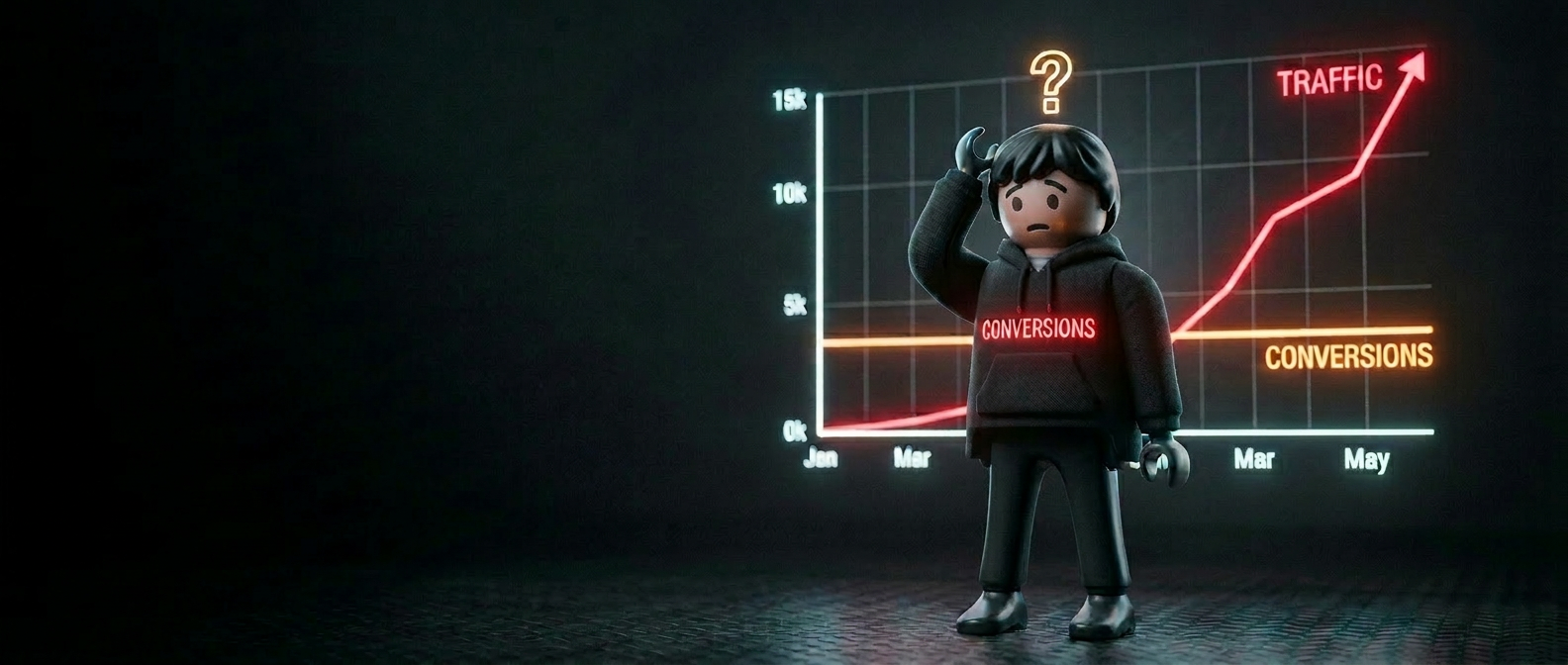
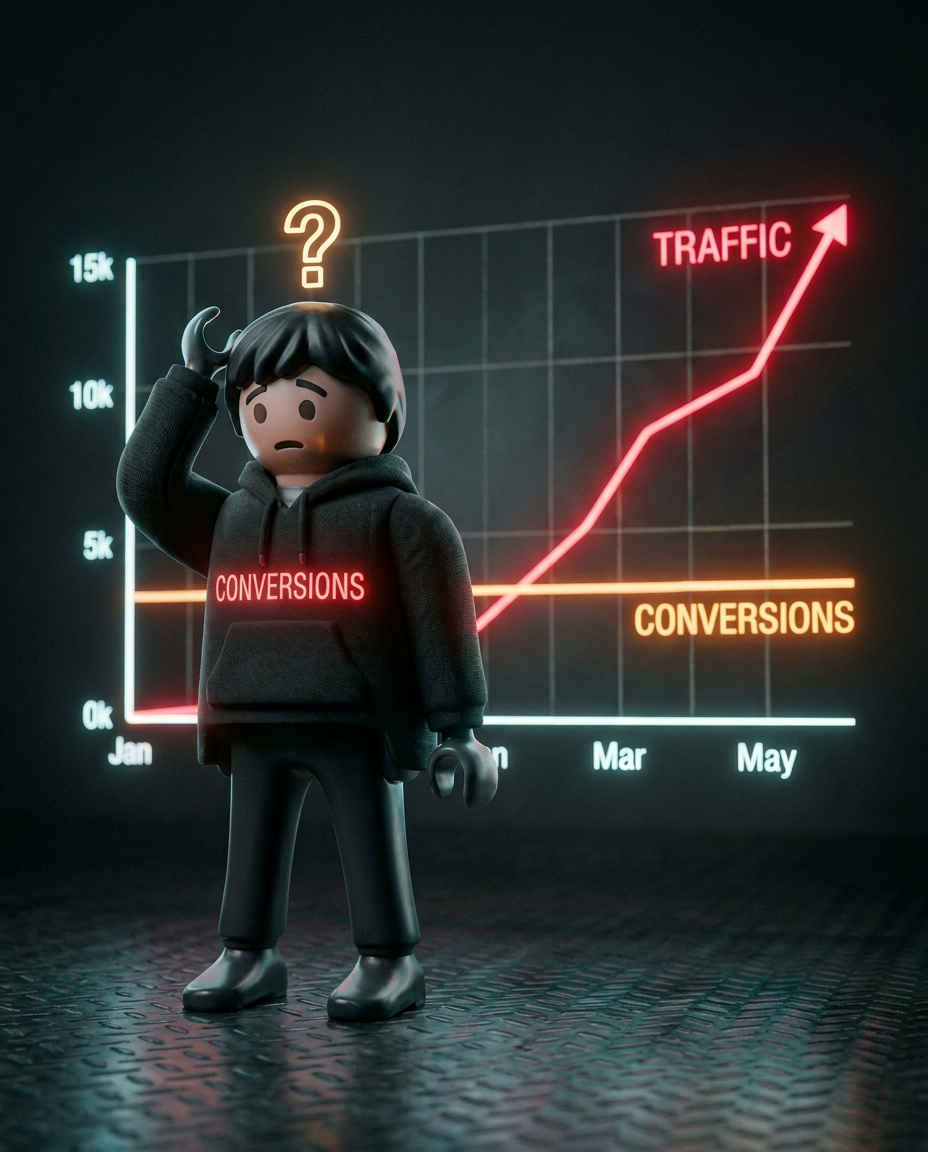
Traffic But No Conversions? Three Things to Fix Before Anything Else
Traffic is vanity. Conversions are survival.
You've got visitors coming to your site. You've got the SEO, maybe some paid, maybe a viral post that landed. But the conversions aren't there. So you do what every founder does: you A/B test the button color. You rewrite the headline. You hire a CRO consultant. You try a new landing page template.
None of it moves the needle. Because you're optimizing the wrong thing.
"Traffic but no conversions" is almost never a traffic problem. It's almost always one of three things: your positioning is off, your messaging doesn't translate it, or your conversion path has too much friction. In that order.
You can't A/B test your way out of a positioning problem.
The Misdiagnosis
Here's what most founders think when they see low conversion rates:
- •"We need a better CTA."
- •"The design is probably wrong."
- •"We need more social proof."
- •"The page loads too slowly."
These things matter, but they're downstream of the real problem. You can have the fastest-loading, best-designed, most proof-packed page on the internet and still convert nobody if the person landing on it doesn't immediately understand why this is for them.
The misdiagnosis costs real money. You burn budget on retargeting campaigns, paid traffic, and design sprints , all on top of a foundation that was never solid. I've seen founders spend €30,000 on Google Ads sending people to a page that was never going to convert because the positioning was wrong.
The fix costs nothing. The misdiagnosis costs everything.
Why This Matters More Than You Think
Low conversion rates don't just mean fewer customers. They break your entire unit economics model.
Your CAC payback period is a function of how much you spend to acquire a customer divided by the margin they generate. When your conversion rate is low, you need more traffic to hit the same number of customers , which means more spend, higher CAC, longer payback.
| Conversion Rate | Visitors Needed for 100 Customers | CAC at €1/visitor | CAC at €2/visitor |
|---|---|---|---|
| 1% | 10,000 | €100 | €200 |
| 3% | 3,333 | €33 | €67 |
| 5% | 2,000 | €20 | €40 |
| 8% | 1,250 | €12.50 | €25 |
Moving from 1% to 5% conversion doesn't just improve your conversion rate by 5x. It cuts your CAC by 80%. That changes everything about your ability to grow profitably. It means the difference between a business that works and one that bleeds.
For context: B2B SaaS landing pages average 3.8% conversion. If you're below that, you have a structural problem that more traffic won't fix.
Layer 1: Positioning
Positioning is the foundation. It answers one question: "Why should this specific person choose this over everything else they could do instead?"
Not "what is this product." Not "how does this work." Why you, for them, now.
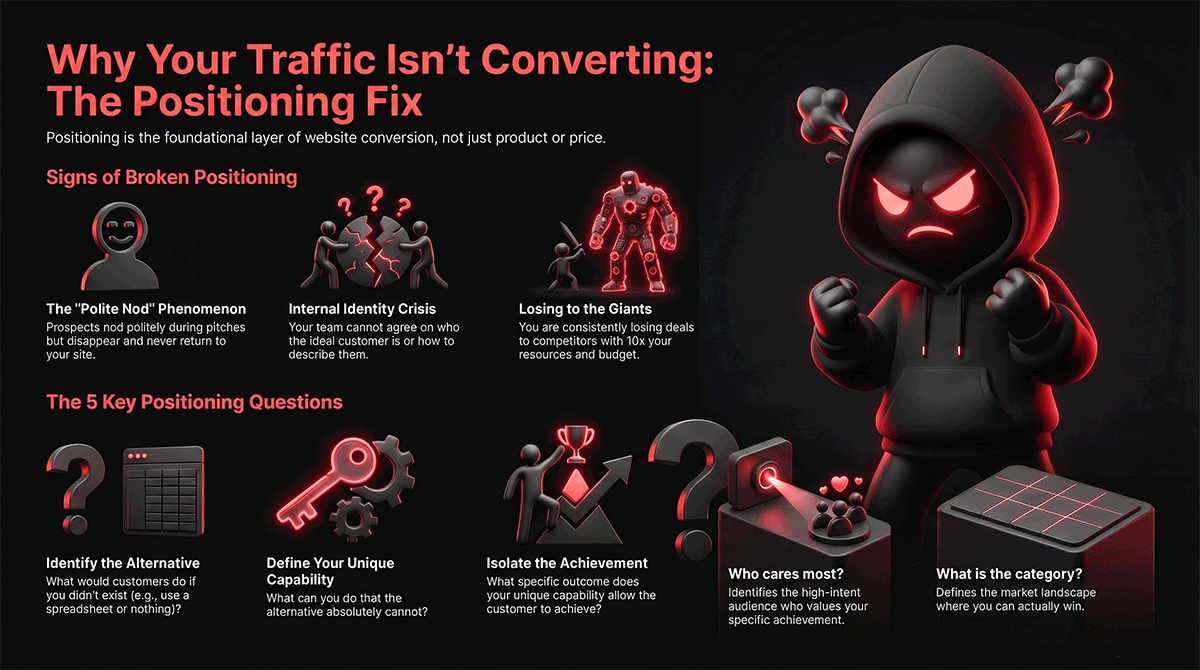
When positioning is broken, your visitors feel a familiar friction. They read the page. They nod along. They don't quite get why it's for them. They leave. You think the problem is design. It's not.
Signs your positioning is broken
- •People say "interesting" and never come back.
- •The first question prospects ask is "how is this different from X?"
- •You're attracting the wrong ICP , people who aren't ready to pay, or who have different problems.
- •Sales cycles are long because you spend half the call explaining what you do.
- •Your existing customers use completely different language to describe you than you use to describe yourself.
That last one is the tell. Your customers know what you are better than you do, because they're the ones who actually chose you. Go read your positive reviews, your customer interviews, the messages where someone told a colleague about you. That language is your positioning.
The positioning diagnostic question
Can you complete this sentence in one breath?
"[Product] helps [specific person] who [has specific problem] to [achieve specific outcome] unlike [alternative] which [limitation]."
If you can't , or if you can but your customers wouldn't recognise themselves in it , your positioning needs work before anything else does.
The fix isn't a brainstorming session. It's customer conversations. Talk to the five customers who love you most. Ask them: what were you doing before this? What made you look for a solution? How did you decide? What would you tell a colleague who had the same problem?
Then talk to five people who visited your site and didn't convert. Ask the same questions. The gap between those two conversations is where your positioning work lives.
More on finding and converting the right people: How to Get Your First 100 Users.
Layer 2: Messaging
Positioning is what you stand for. Messaging is how you say it.
You can have exactly the right positioning , clear ICP, true differentiation, a real pain you solve , and still convert nobody because your messaging is written in your language instead of your customer's.
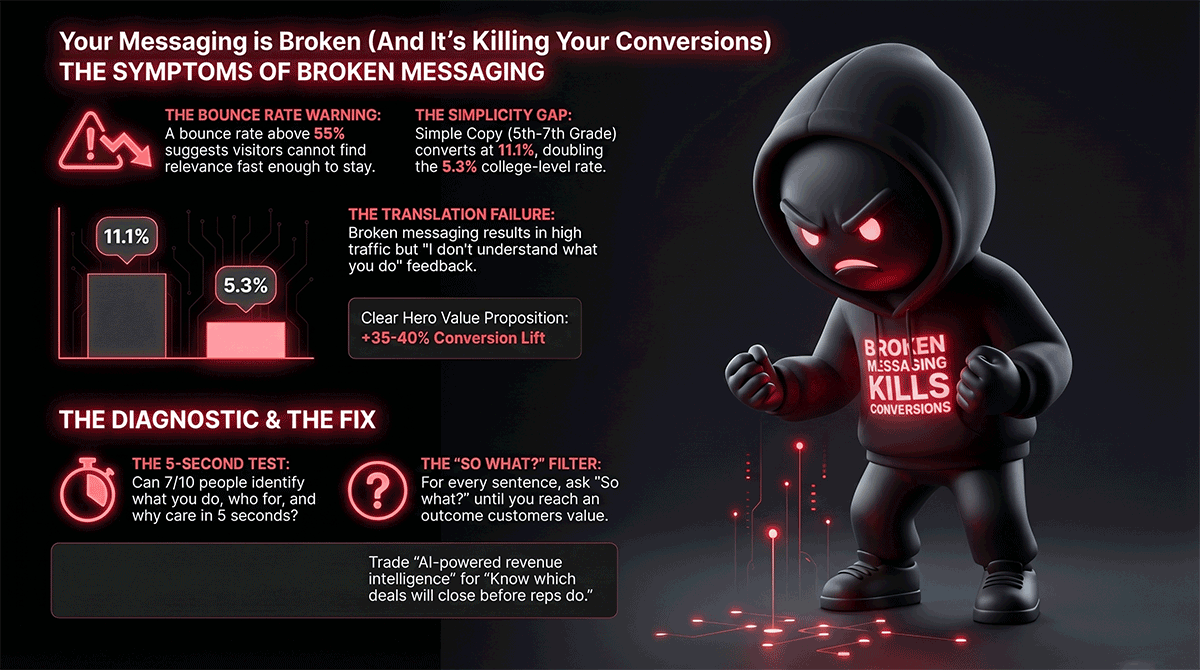
The feature-to-outcome translation gap
Technical founders almost always default to feature language. It's what they know. They built the features, so they lead with the features. The problem: features don't convert. Outcomes do.
| Feature Language (What you say) | Outcome Language (What converts) |
|---|---|
| Real-time data sync across all devices | Your team always works from the same numbers |
| AI-powered recommendation engine | Stop guessing what to stock. Know before it runs out. |
| Automated compliance reporting | Close your books in hours, not weeks |
| Multi-tenant architecture with role-based access | Your whole company in one place, without IT tickets |
The rule is simple: nobody buys features. They buy the future version of their life or business after using your product. Write about that.
The jargon problem
Every industry has jargon. The question isn't whether to use it , sometimes the right jargon signals credibility and belonging , but whether your customer uses the same jargon you do.
If you call it "workflow orchestration" and your customer calls it "getting the team to stop emailing spreadsheets to each other," you're talking past each other. They'll read your page and think "this isn't for me" even if it solves their exact problem.
Again: go read how your customers describe your product in their own words. The language that makes them say yes is the language you should be leading with.
The messaging audit
Read your homepage out loud. For every sentence, ask: "Is this a feature or an outcome?" and "Would my best customer use this exact phrase?"
If most of your sentences are features and your customers wouldn't recognize the language , rewrite from their words, not yours.
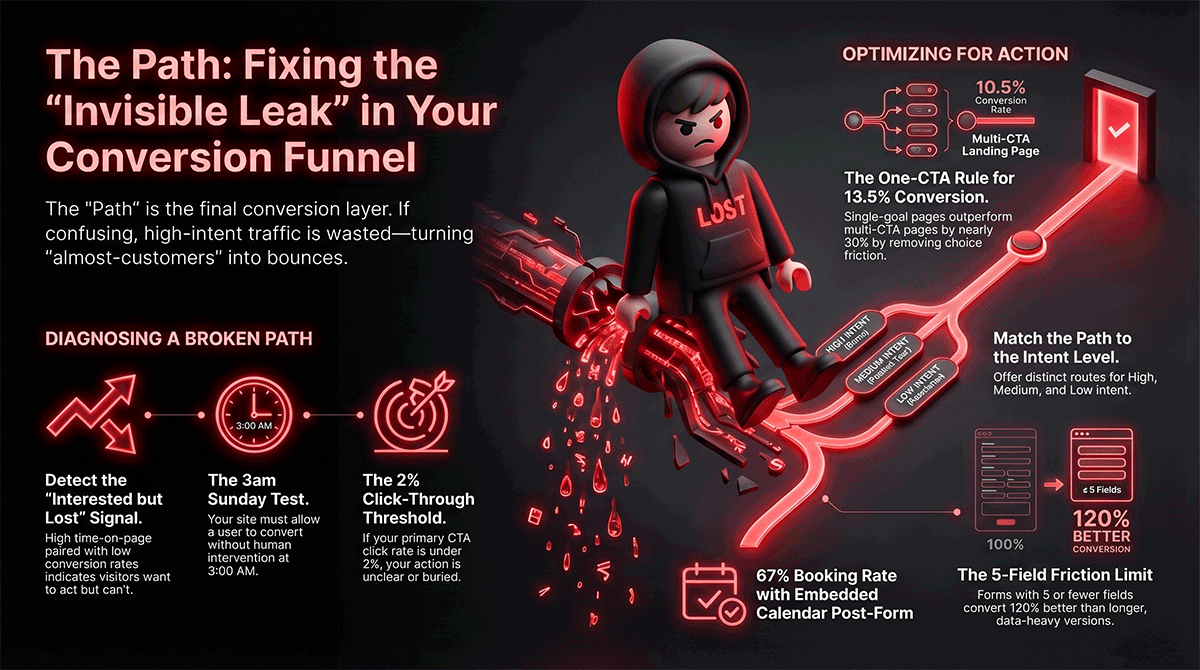
Layer 3: Path
Positioning tells people why you're for them. Messaging tells them how. Path is everything between intent and action , the actual journey from "I'm interested" to "I signed up."
Even with perfect positioning and messaging, a broken path kills conversions. And path problems are sneaky because they often feel like they're working fine , until you watch a real user try to navigate them.
Common path killers
- 1.
Too many CTAs
When everything is a priority, nothing is. "Start free trial," "Book a demo," "Watch a video," "Download our guide" , four options creates decision paralysis. Pick one primary action per page based on the visitor's stage of awareness.
- 2.
Wrong CTA for the stage of awareness
A cold visitor who found you through a blog post is not ready to book a sales call. But a visitor who's read three blog posts and come back three times probably is. Mapping the right CTA to the right intent level is non-negotiable.
- 3.
Friction in the signup flow
Every field you add to a signup form costs you conversions. Every screen between "I want this" and "I'm in" is a place someone drops off. Ask for only what you absolutely need right now. Get the rest later.
- 4.
Unclear next step
After a demo, what happens? After a trial signup, what should I do first? If the next step isn't obvious, people default to doing nothing. Make the next step explicit, singular, and low-effort.
- 5.
Mobile experience as an afterthought
More than half your traffic is probably on mobile. If your conversion path requires desktop, you've cut your addressable audience in half before you even start.
Path problems are the easiest to fix and the most satisfying to watch improve. A single friction reduction , removing two signup form fields, adding one clearer CTA , can move the needle in days.
The Order Matters
This is where most conversion optimization efforts go wrong. Teams jump straight to path optimization , A/B testing CTAs, reducing form fields, running retargeting , without checking whether positioning and messaging are solid first.
The problem: you can't CRO your way out of a positioning problem. You can reduce friction in a path that's leading the wrong people to the wrong outcome, and you'll just end up with more of the wrong people converting. That looks good in the dashboard and is terrible for the business.
| Layer | Fix it first if... | Signal you can move on |
|---|---|---|
| 1. Positioning | People visit but don't "get it," or you're attracting wrong ICP | Customers describe you in words you'd use to describe yourself |
| 2. Messaging | People understand what you do but don't feel urgency to act | Prospects use your copy language when they refer others |
| 3. Path | People understand and want it but aren't completing the action | Conversion rate at or above benchmark for your segment |
The GTM foundation , positioning included , is covered in detail in The Minimum Viable GTM Stack for B2B Seed. If you haven't built that foundation yet, start there.
The Quick Diagnostic
Run through these in order. Stop at the first layer where you find a problem. Fix that before moving to the next.
Layer 1: Positioning Check
- Can you complete the positioning sentence (who, what problem, what outcome, unlike what) in one breath?
- Do your best customers describe you in language that matches your homepage?
- Is your ICP narrowly defined enough that visitors immediately know if they're in it?
- Would a visitor know within 5 seconds what you do, who it's for, and why they should care?
- Are you attracting leads who are ready and able to pay?
Layer 2: Messaging Check
- Is your hero section written in outcome language, not feature language?
- Are you using the same words your customers use , not your internal vocabulary?
- Does every page have one clear primary message, not five competing ideas?
- Does your copy create urgency, or does it just describe?
- Would your best customer forward this page to someone else who has the same problem?
Layer 3: Path Check
- Is there one primary CTA on each page , not three competing options?
- Is the CTA matched to the visitor's stage of awareness?
- Can someone complete the primary action in under 2 minutes?
- Have you removed every form field that isn't strictly necessary for the first conversion?
- Is the next step after the primary action explicit, singular, and low-effort?
- Does the path work on mobile?
If you can honestly check every box: your conversion problem is somewhere else , traffic quality, offer-market fit, pricing, or something structural. But most founders can't check all of these, and the ones they can't check tell you exactly where to start.
What Happens When You Get It Right
When positioning, messaging, and path are aligned, conversion is almost automatic. Not because you've hacked anything , because you've built a system where the right people arrive, immediately understand why this is for them, and have a clear path to act on that understanding.
Here's what changes:
- →CAC drops , you're converting more of the traffic you already have, so you spend less to acquire the same number of customers.
- →Sales cycles shorten , prospects arrive already understanding the value, so you spend less time explaining and more time closing.
- →Lead quality improves , your ICP self-selects in, and wrong-fit prospects self-select out before they waste your sales team's time.
- →Word-of-mouth accelerates , customers who understood exactly what they were getting are the ones who recommend you. Confused customers churn and go quiet.
- →Paid channels become viable , once your conversion rate is solid, you can pour paid traffic into it and it works. Before that, you're just burning money on top of a leaky bucket.
Fix the bucket before you turn on the tap.
Traffic is not the problem. Traffic has never been the problem. The problem is what happens to traffic when it arrives.
Start with positioning. Then messaging. Then path. In that order, one layer at a time.
And if you want to see what cleaning up your conversion rate actually does to your numbers, use the CAC Payback Calculator to model it before you spend another euro on traffic.
Not sure where your conversion is breaking?
Book 20 minutes and we'll diagnose the layer , positioning, messaging, or path , and figure out the fastest fix.

About Judie Alvarez
Judie Alvarez is a fractional CMO helping Seed to Series A startups build distribution that compounds. She's driven +208% traffic growth, 60% CAC reductions, and helped secure €8M+ valuations through data-driven growth strategies.
Learn more →