
The Minimum Viable GTM Stack for D2C Seed (2026)
The D2C playbook everyone's selling you is from 2021.
Expensive brand shoots. Big influencer deals. Trust the Meta dashboard. Build community before revenue.
That playbook worked when capital was cheap and attention was underpriced. Neither is true anymore.
And here's what most "D2C experts" miss: not all D2C is ecommerce.
When I say D2C, I mean any business selling directly to the end user. No middleman. That could be physical products, software, subscriptions, access, experiences, services. Adobe is D2C. Spotify is D2C. Notion is D2C. Superhuman is D2C. Canva is D2C.
The mechanics differ. The principles don't.
Here's what you actually need. Infrastructure first, then execution.
Building for B2B instead?
Nine foundational assets every B2B seed startup needs to build pipeline. The asset list is different.
Part 1
The Stack
The stack is infrastructure. Things you build once that enable everything else.
Four things. That's it.
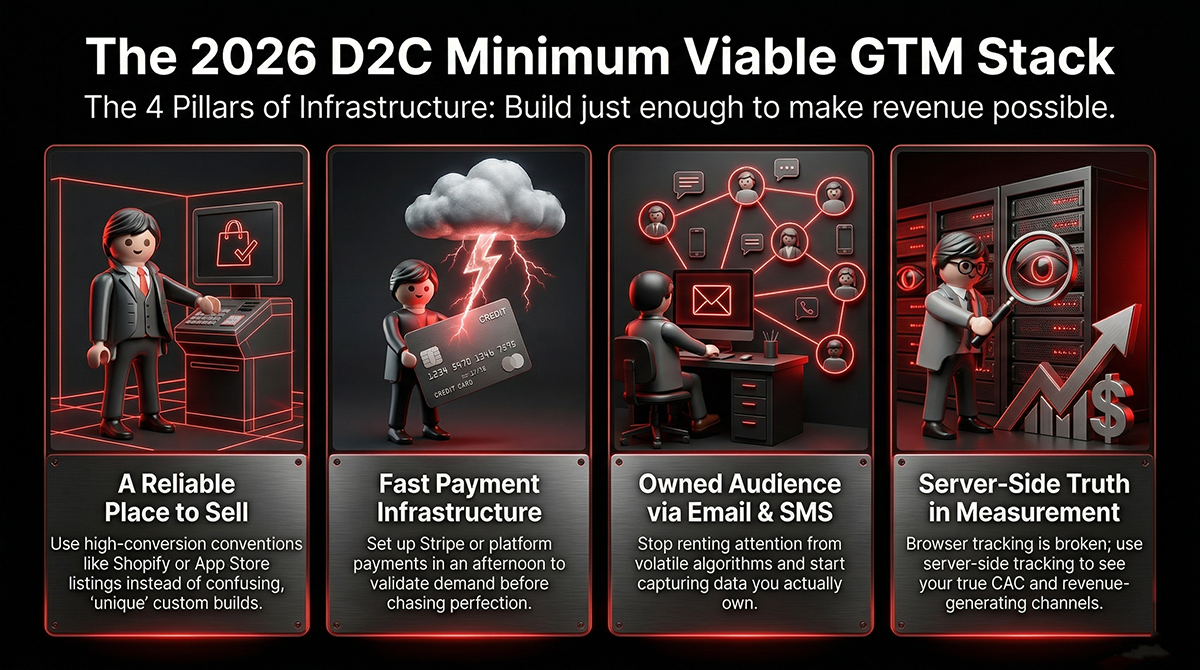
1. A Place to Sell
What it is: Somewhere the transaction happens. A Shopify store. A TikTok Shop. An App Store listing. A landing page with a payment link. Gumroad. Lemon Squeezy. Your own site. It doesn't matter which one.
Why you need it: Don't overcomplicate it.
I worked with a travel startup that lost sales because people didn't know where to click. The checkout was confusing. The upsells were hidden. They'd designed something "unique" instead of something that worked.
Ecommerce and SaaS have studied conversion behavior for decades. CTA positions. Checkout flows. Signup patterns. The conventions exist because they've been tested millions of times. Use them.
You can't act like Prada when nobody knows your name.
Done looks like
- ✓People can find what you sell
- ✓People can pay you (or sign up, or book)
- ✓It works on mobile
- ✓It follows conventions
What to skip
Custom builds before you have traction. "Unique" experiences that confuse people. Perfection before validation.
2. A Way to Take Money
What it is: Payment infrastructure. Stripe for most things. Paddle if you want handled taxes and compliance for software. App Store or Google Play if you're mobile-first. Platform payments if you're selling through TikTok Shop or Shopify.
Why you need it: This should take an afternoon. Not a month.
I had a hobby ecommerce business. Made good money. Also made every mistake. The biggest one? Wanting everything perfect before validating demand. You need a way to show what you're selling and a way to take money. That's it. Validate demand before you chase perfection.
Done looks like
- ✓You can accept money today
- ✓Multiple payment options for your market
- ✓Automated receipts and basic reporting
What to skip
Building custom payment flows. Negotiating enterprise payment terms at seed stage.
3. A Way to Own Your Audience
What it is: Email and SMS.
Why you need it: This is the difference between renting attention and owning it. Meta can raise prices. TikTok can change the algorithm. Google can bury you. Apple can reject your app update. Your email list is yours.
The first time we had a million visitors hit our site, the servers nearly broke. Frustrating enough. But the real failure? We didn't have a compelling way to capture them. They came, looked, left. Gone forever.
We learned. Added a "dream trip" capture at the travel startup. "Jobs direct to inbox" at The Hub. Something valuable enough to trade an email for.
In 2026 this matters more than ever. CAC keeps rising. The only sustainable path is owning your audience.
Done looks like
- ✓Email capture with a real value exchange (not "subscribe to our newsletter")
- ✓SMS for high-intent moments if relevant to your business
- ✓Welcome sequence that delivers value immediately
- ✓Basic segmentation from day one
What to skip
"Join our mailing list" popups. Buying lists. Complex automation before you have 1,000 subscribers.
4. A Way to Know What's Working
What it is: Measurement that tells the truth.
Why you need it: Meta and Google lie to you. This isn't opinion. It's math.
Browser-based tracking is broken. Privacy regulations, ad blockers, iOS changes. Multiple platforms claim credit for the same conversion. Your ROAS looks great while you bleed money.
At very early stage, you can get away with imperfect data. But as soon as you're spending real money on acquisition, server-side tracking becomes critical.
How server-side tracking works
Your server talks directly to the ad platforms, bypassing the browser. Clean data. Real attribution. Algorithms that can actually optimize because they're seeing true conversions.
I wrote a full breakdown on this. How it works, what it costs, how to set it up.
Done looks like
- ✓Server-side tracking connected to your ad platforms
- ✓One source of truth for what drives conversions
- ✓True CAC and payback visibility
- ✓Weekly review: what's actually generating revenue?
What to skip
Trusting native ad dashboards. Complicated attribution models before you have volume.
Part 2
The Execution
The stack is infrastructure. Execution is what you do with it.
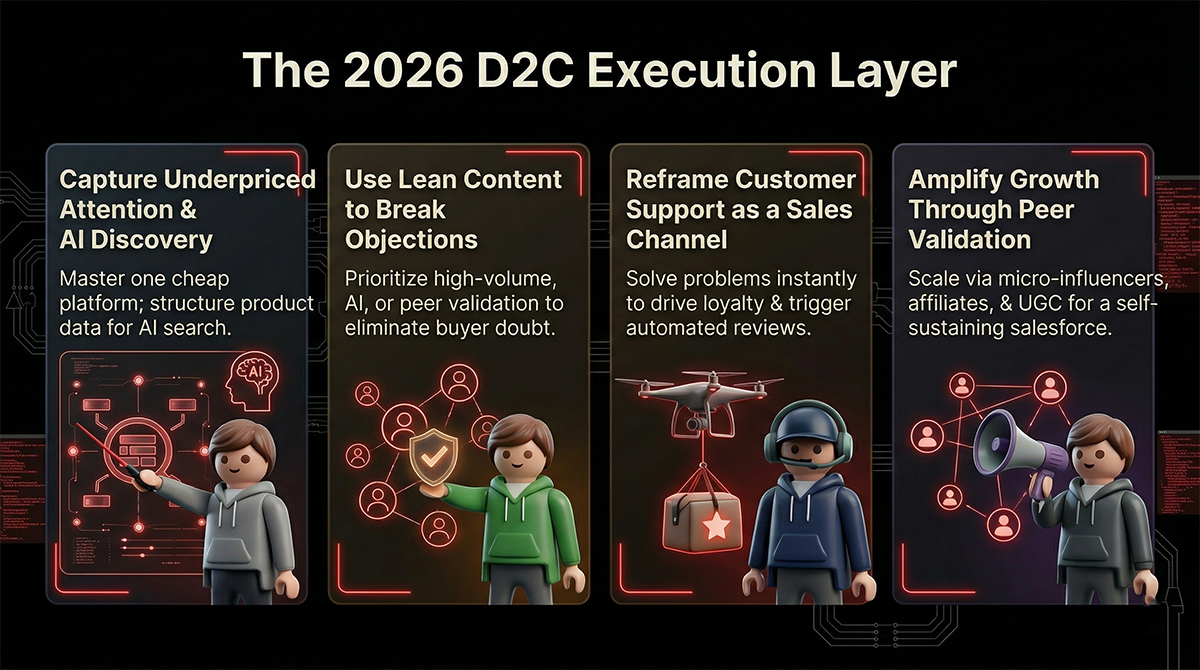
Discovery: Find Underpriced Attention
Discovery is about one thing: finding underpriced attention before everyone else does.
I worked with a travel startup where TikTok was the answer in 2023. Fun routes you could buy on the spot. Some videos hit over a million views. The platform was underpriced for that audience at that moment.
With The Hub and TechBBQ, it was LinkedIn. Startup job seekers lived there.
For software, it might be Product Hunt, Twitter/X, niche communities, YouTube tutorials, or SEO content that ranks for problems you solve.
The channel depends on your audience. Your ECP first (the early customers who buy fast) then ICP later.
There's a new discovery layer most founders are ignoring: AI.
87%
of commercial queries on ChatGPT surfaced shopping results in early 2026
40%
of D2C traffic now starts in DMs and messaging channels
Consumers ask AI what to buy, what to use, what to try. If AI can't read your product, you don't exist in those moments. Schema markup. FAQs. Reviews structured so LLMs understand them. This isn't optional anymore.
Done looks like
- ✓One channel mastered before adding another
- ✓5+ posts per week minimum
- ✓Content native to the platform
- ✓Product or service data structured for AI discovery
Content: Break Objections
All content is objection-breaking. That's the only job.
You're not going to say your product is bad. So don't expect anyone to believe you when you say it's great. Peers do that work.
At The Hub, we shared the top companies hiring on our platform. Everyone wanted to be on that list. They'd share it. New companies joined. Their sharing gave our claims more weight than anything we could have said ourselves.
For production: at The Hub we used Canva and Envato assets on repeat. We were lean. In 2026 you can generate to your heart's content with AI tokens. No excuses for expensive production.
Done looks like
- ✓Content that answers objections
- ✓Peer validation visible: customers, partners, recognizable names
- ✓Lean production: Canva, Envato, AI tools
- ✓Volume over perfection
Retention: Support Is Sales
Support is your best sales channel. Most founders just don't treat it that way.
They see it as a cost center. Handle complaints. Minimize tickets. Wrong.
A problem solved well creates more loyalty than no problem at all.
In consumer software, this is where you turn free users into paid users, and paid users into people who tell their friends. In physical products, 40% of D2C traffic now starts in DMs. The question asked in a message is often one step from a purchase.
For reviews: strike when the iron is hot. Support just solved a problem? Ask right then. Otherwise people only review when something goes wrong.
Done looks like
- ✓Fast responses (hours, not days)
- ✓Support that can actually solve problems
- ✓Review requests tied to positive interactions
- ✓Post-purchase or post-signup follow-up that adds value
Amplification: Peer Validation at Scale
This looks different depending on what you sell.
For software and digital products:
Hundreds of software companies you already use have partnership and affiliate programs. ManyChat, Squarespace, Notion, Canva, Webflow, Zapier. If you love a tool and have an audience, you can get paid to recommend it. And if you're building a tool, creating a partnership program lets your users become your salesforce.
Template marketplaces, integration directories, and "built with" galleries are underrated distribution. If your software integrates with something popular, get listed.
For physical products and experiences:
At the travel startup, we sent micro-influencers on trips. They got the experience. We got content. They posted. We got reach. If they drove sales, they got commission. Everyone aligned.
Micro-influencers (5k-50k followers) with commission structures beat expensive flat-fee deals almost every time. Authentic. Aligned incentives. Measurable.
For any D2C business:
Your customers talking about you is worth more than any ad. Build triggers that make it easy: referral programs, shareable moments, incentives for reviews.
Done looks like
- ✓Partnership or affiliate structure that aligns incentives
- ✓Presence in directories, marketplaces, or galleries relevant to your product
- ✓UGC or customer content you can repurpose
- ✓Reviews structured so AI can read them
The 2026 D2C Stack
If you remember nothing else, this is the stack:
| Layer | What It Is | What "Done" Looks Like |
|---|---|---|
| STACK | ||
| Place to Sell | Where the transaction happens | Works, follows conventions, mobile-ready |
| Payments | How you take money | Set up in an afternoon, multiple options |
| Audience Ownership | Email/SMS capture | Compelling offer, welcome sequence, segmented |
| Measurement | Server-side tracking | One source of truth, real CAC visibility |
| EXECUTION | ||
| Discovery | Underpriced attention | One channel mastered, AI-discoverable |
| Content | Objection-breaking | Peer validation, lean production, volume |
| Retention | Support as sales | Fast, solves problems, triggers reviews |
| Amplification | Peer validation at scale | Partnerships, directories, referrals, UGC |
Build the Stack. Execute Lean.
Four pieces of infrastructure. Everything else is execution on top.
The 2021 playbook (expensive shoots, big influencer deals, trusting broken dashboards) is dead.
Build lean. Use the new tools. Own your audience. Know your real numbers.
Build just enough stack to make revenue possible. Then iterate from there.

About Judie Alvarez
Judie Alvarez is a fractional CMO who has built D2C and SaaS go-to-market strategies across physical products, software, and subscription businesses. She helps seed-stage founders build the infrastructure that generates revenue without burning runway.
Learn more →You've Got the Stack. Now Deploy It.
The 90-Day GTM Framework walks you through execution, week by week, channel by channel.
Related Articles

How to Sell to Companies as a New Startup (Without Case Studies or Brand)

Traffic But No Conversions? Three Things to Fix Before Anything Else

How to Get Your First 100 Users
Now go get your first 100 users
The stack is built. Here's the tactical playbook for finding your first customers, from manual to scale.